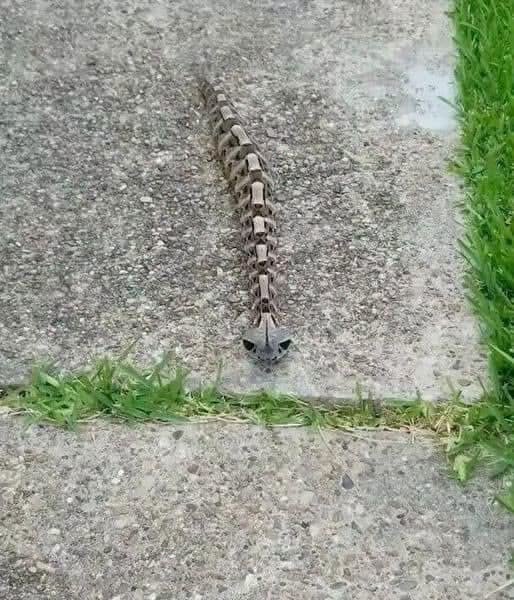
A Snake That Can Almost Disappear
The Gaboon viper is found in parts of sub-Saharan Africa, particularly in forested habitats and areas with abundant leaf litter. Its body is covered with intricate patterns of brown, cream, tan, and purple-like shades that can make it surprisingly difficult to distinguish from fallen leaves and vegetation.


7
This camouflage is more than just visually impressive. It helps the snake remain concealed while waiting for potential prey to come within range.
Rather than actively chasing animals for long distances, the Gaboon viper generally relies on patience and concealment. Remaining still can be an effective strategy when your surroundings provide excellent cover.
An Impressive Physical Design
The Gaboon viper is one of Africa’s largest vipers. It has a heavy body, a broad triangular head, and distinctive markings that make it instantly recognizable once you know what to look for.
One of its most remarkable features is its exceptionally long fangs. Like other vipers, it has specialized teeth designed to deliver venom during a bite. These fangs can be remarkably long relative to those of many other venomous snakes.
Its venom is medically significant and can cause serious effects following a bite. Fortunately, encounters with people are uncommon because the snake generally prefers habitats away from heavily populated areas.
A Patient Ambush Predator
The Gaboon viper’s hunting technique is based largely on patience.
Instead of constantly searching for food, it can remain concealed and wait for suitable prey to approach. When an opportunity appears, the snake can strike with impressive speed.
Its diet may include a variety of animals, including rodents, birds, and other appropriately sized prey. This flexible diet helps it take advantage of the animals available in its environment.
After securing its meal, the snake relies on its powerful digestive system to process the food.
Why Is It So Difficult to Spot?
The answer lies in its extraordinary pattern.
Imagine looking down at a forest floor covered with dry leaves, twigs, shadows, and patches of sunlight. A Gaboon viper resting among that debris may blend into the surroundings remarkably well.
This is a classic example of camouflage, an adaptation that can help animals avoid detection and improve their chances of successfully hunting.
Its relatively calm behavior also means that it isn’t constantly moving around looking for confrontation. In fact, its best defense may simply be remaining unnoticed.
Should People Be Afraid?
The Gaboon viper deserves respect because its venomous bite can be dangerous. However, that doesn’t mean the snake is constantly looking for people to attack.
Like many wild animals, it generally prefers to avoid unnecessary encounters. Most potential encounters occur when a person unknowingly gets very close to a concealed snake.
The safest approach is simple: observe wild snakes from a distance and never attempt to handle or provoke them.
If someone is bitten by a venomous snake, they should seek emergency medical attention immediately rather than attempting home remedies or trying to capture the animal.
A Remarkable Example of Evolution
The Gaboon viper may look intimidating, but its most fascinating quality isn’t simply its venom. It’s the combination of adaptations that allows it to survive.
Its elaborate coloration, powerful body, specialized fangs, patient hunting strategy, and ability to remain hidden all work together.
The next time you look at a photograph of a forest floor, it’s worth remembering that nature can hide some extraordinary creatures in plain sight.
The Gaboon viper isn’t the most dangerous animal because it seeks out humans—it is fascinating because it has evolved to become extraordinarily effective at living quietly within its environment.