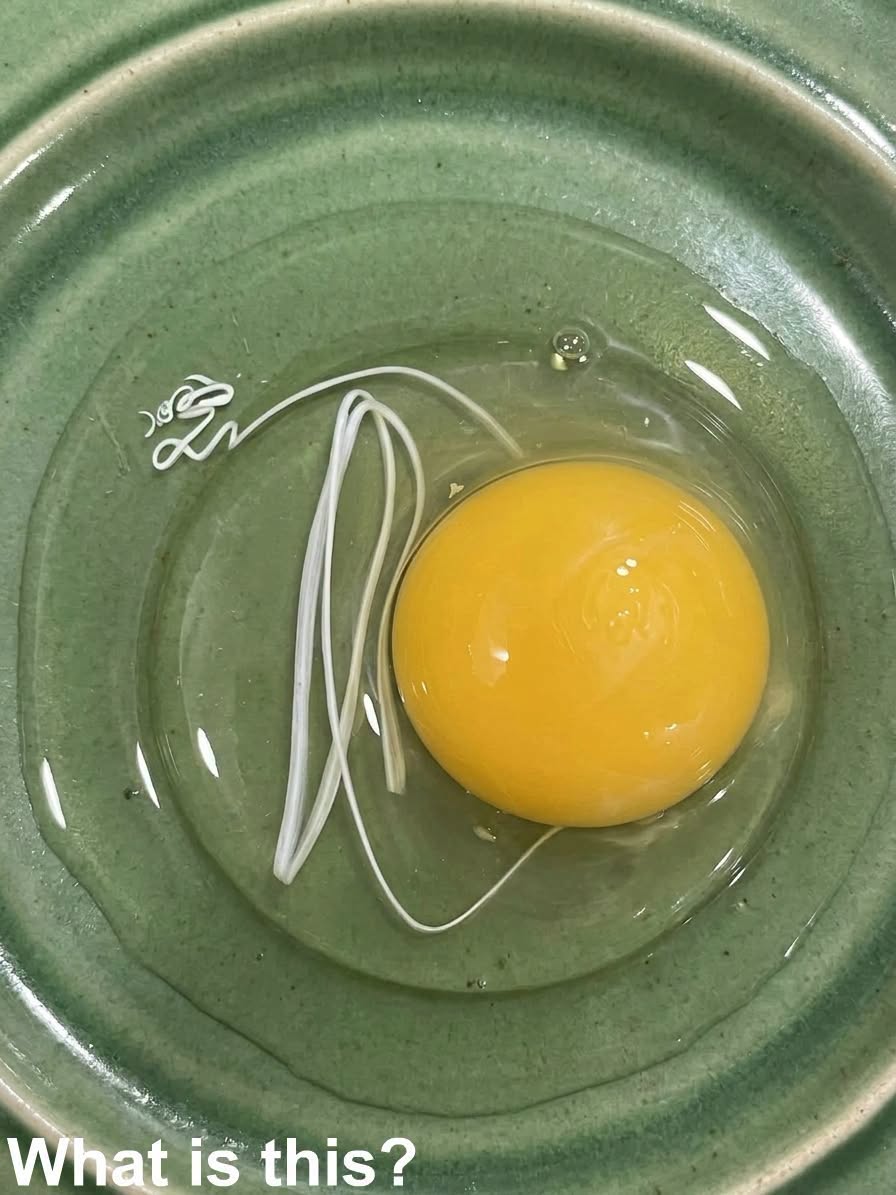
I had never paid much attention to the details inside an egg before, and because the strand looked unfamiliar, my first reaction was concern. Was the egg still good? Was this something I shouldn’t eat?
Instead of guessing, I decided to find out what I was looking at.
The Strange White Strand Had a Name
After checking reliable food and cooking references, I discovered that the mysterious strand was most likely a chalaza.
Chalazae are naturally occurring structures inside eggs. They are made from strands of egg-white proteins and help keep the yolk positioned within the egg.
In other words, what looked unusual was actually a normal part of the egg.
There wasn’t anything mysterious hiding inside my breakfast after all.
Why Does the Chalaza Look So Strange?
The chalaza can appear as a white, twisted or rope-like strand attached to the yolk.
Its appearance can vary from egg to egg. Sometimes it is barely noticeable, while in other eggs it can be quite prominent.
That difference can make it surprising if you’ve never noticed one before.
Because the chalaza is white and somewhat stringy, it can easily be mistaken for something foreign when someone sees it for the first time.
But its unusual appearance doesn’t mean the egg is spoiled.
Does Seeing a Chalaza Mean the Egg Is Fresh?
A visible chalaza is generally considered a normal feature of a fresh egg.
As eggs age, the egg white gradually becomes thinner, which can make the chalaza less noticeable. A clearly defined chalaza can therefore be one indication that an egg is relatively fresh, although it shouldn’t be used as the only test of freshness.
There are better ways to assess an egg before eating it.
What Should You Actually Look For?
When checking an egg, pay attention to its smell, appearance, shell condition, and storage history.
After cracking an egg, an unpleasant or unusual odor is a much more important warning sign than the presence of a white strand.
Likewise, unexpected discoloration, mold, or other obvious signs of spoilage should be taken seriously.
A normal-looking chalaza, however, is not something that needs to cause alarm.
Why I Had Never Noticed It Before
The funny thing is that I had probably seen chalazae many times without realizing what they were.
Most of us don’t examine an egg closely before putting it into a frying pan, mixing bowl, or cake batter. We simply crack it and continue cooking.
Once I knew what the structure was, I started noticing it more often.
What had initially looked strange suddenly seemed completely ordinary.
It was a small reminder of how easily unfamiliar things can appear alarming when we don’t know what we’re seeing.
A Tiny Detail Hidden in an Everyday Food
Eggs are such familiar foods that it’s easy to forget they’re biological structures with several different components working together.
The yolk, albumen, membranes, and chalaza each have their own roles. The chalaza helps stabilize the yolk so it remains positioned within the egg rather than moving freely.
So that strange little white ribbon wasn’t a sign that something had gone wrong.
It was simply part of how the egg was naturally constructed.
The Lesson From One Unexpected Breakfast Discovery
My morning started with a moment of uncertainty over something that looked completely unfamiliar.
A few minutes of research changed that reaction entirely.
The next time I crack an egg and notice a white, twisted strand beside the yolk, I won’t be reaching for the trash can. I’ll know that I’m looking at a normal part of the egg.
Sometimes the things that look the strangest are simply the things we’ve never taken the time to notice.
And in this case, one unusual-looking egg turned an ordinary breakfast into a surprisingly interesting little lesson in food science.