Why Would Someone Hang Pasta Outdoors?
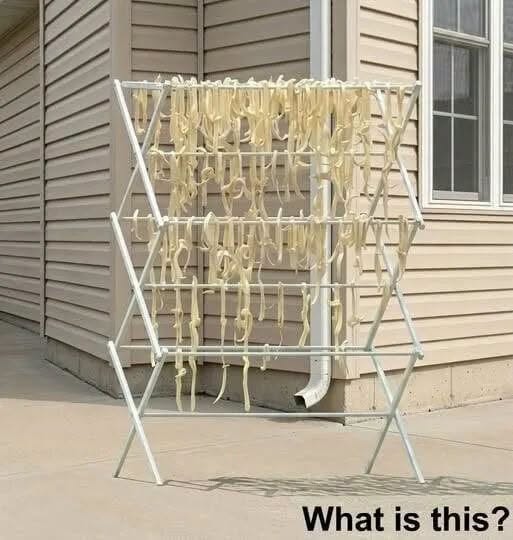
For people who have never made fresh pasta at home, the sight can be surprisingly unfamiliar.
After pasta dough is prepared, rolled, and cut into long pieces, the strands need to remain separated so they don’t stick together. Home cooks may use drying racks or other appropriate supports while preparing the pasta for cooking or further storage.
Inside a kitchen, the process might seem completely ordinary.
In a backyard, rows of pale pasta can look like something entirely different.
That’s what made the scene so intriguing.
The Reason Pasta Is Dried
Fresh pasta contains moisture from its ingredients. Drying removes some of that moisture and changes the pasta’s texture.
For pasta intended for storage, proper drying is particularly important. Homemade pasta doesn’t automatically become suitable for long-term storage simply because it has been left out to dry, however. Factors such as ingredients, humidity, temperature, cleanliness, and the intended storage method all matter.
Anyone planning to preserve homemade pasta should follow reliable food-safety guidance rather than relying solely on appearance or tradition.
Still, the basic idea behind drying food is anything but new.
An Old Technique That Still Appears Today
Long before modern refrigerators and packaged foods became commonplace, people developed ways to preserve ingredients for later use.
Drying was among the simplest approaches. Depending on the culture and available ingredients, people have traditionally dried fruits, vegetables, grains, herbs, meats, and other foods.
Pasta is another example of a food that can be prepared in ways designed to reduce moisture and make storage more practical.
Modern food production has made the process much more controlled, but traditional preparation methods remain part of home cooking in many places.
Why Did It Look So Strange?
The location was probably the biggest reason the scene seemed mysterious.
Most people expect to see laundry, plants, gardening equipment, or outdoor furniture in a backyard. Long strands of pasta don’t immediately fit that mental picture.
When we encounter something unfamiliar, our brains naturally try to compare it with things we already recognize.
That can lead to some amusing first impressions.
Once someone explains that the strands are pasta, though, the entire scene suddenly becomes understandable.
Nothing about the backyard has changed.
Only the information available to the observer has changed.
Sometimes Context Is the Missing Piece
This is one reason ordinary objects can occasionally seem mysterious when viewed without context.
A strange noise can become completely ordinary after its source is identified. An unfamiliar tool may look complicated until someone demonstrates what it does. Even an everyday household object can seem confusing when seen outside the environment where we normally encounter it.
The same thing happened here.
Before the explanation, the hanging strands were puzzling.
Afterward, they were simply food being prepared.
A Simple Reminder to Look Twice
There is a small lesson in this unusual-looking backyard scene.
Something unfamiliar isn’t necessarily extraordinary. Sometimes we simply don’t have enough information to understand what we’re seeing.
Rather than immediately assuming the most dramatic explanation, taking a closer look or asking a question can reveal a much more straightforward answer.
In this case, there was no elaborate mystery behind the unusual display.
Someone was simply making pasta.
And what initially looked like a strange backyard installation turned out to be a glimpse of a traditional cooking practice.
Sometimes the most curious sights have the simplest explanations.