What Did the Photograph Actually Show?
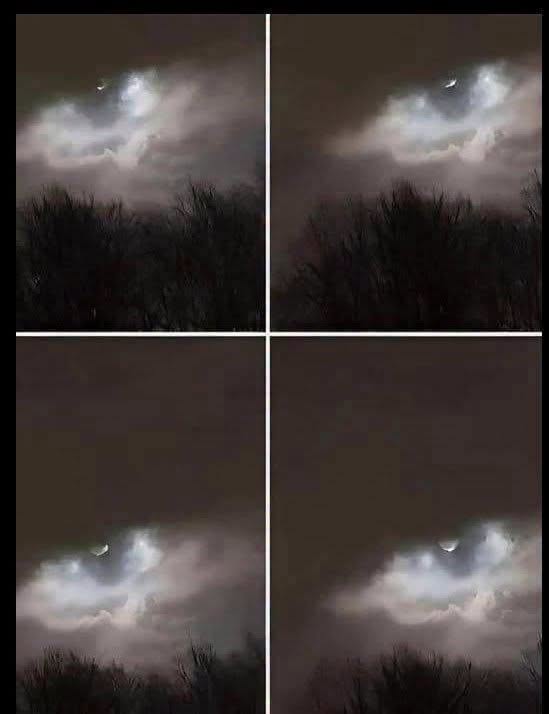
The image appears to show a naturally formed cloud against the sky.
Because clouds are constantly changing shape as they move through the atmosphere, their outlines can sometimes resemble objects, animals, faces, or other recognizable forms.
This can be especially noticeable when lighting, shadows, and the surrounding sky create strong contrasts.
There is no need to assume that an unusual-looking cloud has a mysterious origin simply because its shape appears familiar.
Why Do People See Different Things in the Same Cloud?
One reason is a phenomenon called pareidolia.
Pareidolia describes the tendency of the human brain to recognize familiar patterns in vague or ambiguous shapes. A common example is seeing a face in a cloud, a rock formation, or an arrangement of objects.
The brain is constantly looking for patterns because recognizing familiar shapes quickly can be useful in everyday life.
As a result, two people can look at exactly the same cloud and notice completely different things.
One person might see an animal, another might see a person’s profile, while someone else might simply see an unusual collection of clouds.
None of those interpretations necessarily means that the cloud was deliberately shaped that way.
Weather Can Produce Some Remarkable Shapes
Cloud formations can look surprisingly dramatic without anything unusual happening.
Their appearance is influenced by several ordinary atmospheric factors, including moisture, temperature, air movement, wind direction, and sunlight.
As air rises, cools, and interacts with surrounding air masses, water vapor can condense into tiny droplets or ice crystals. The resulting clouds can develop irregular edges and constantly changing structures.
From the ground, those structures can occasionally create shapes that look remarkably familiar.
The fact that a formation appears unusual doesn’t necessarily mean the weather itself was unusual.
Why the Photograph Became So Interesting
The most fascinating part of the story may not be the cloud itself, but the way people reacted to it.
Once someone suggests that a cloud resembles a particular object or figure, other viewers may begin looking for the same shape.
That can make the resemblance seem stronger with each new observation.
Social media can amplify this effect. A photograph shared with a dramatic caption may encourage viewers to search for something extraordinary before they have considered ordinary explanations.
As more people comment on the image, interpretations can quickly become part of the conversation even when they are simply personal impressions.
A Photograph Doesn’t Always Tell the Whole Story
Images can be compelling, but they still need context.
A photograph may not reveal exactly when it was taken, how long the formation lasted, what the surrounding weather conditions were, or how the scene looked from another angle.
Lighting and camera settings can also influence how a cloud appears in a photograph.
For that reason, it is useful to distinguish between what can actually be observed and what viewers believe the image represents.
The observable fact is that an unusual-looking cloud was photographed.
The interpretation of what the cloud resembles is subjective.
There Is Nothing Wrong With Being Curious
Finding a familiar shape in a cloud is a perfectly ordinary part of human perception.
People have been fascinated by unusual cloud formations for generations. Looking at the sky and imagining recognizable figures can be entertaining, and different interpretations can make a simple photograph more interesting.
The important distinction is between enjoying an unusual image and presenting an interpretation as established fact.
A curious photograph does not automatically provide evidence of something mysterious or supernatural.
The Simple Explanation May Be the Most Interesting One
The photograph offers a useful reminder about how perception works.
Our brains are remarkably good at finding patterns, sometimes even when those patterns are created by coincidence.
A cloud may have no specific meaning or intended shape, yet our minds can still transform it into something familiar.
That doesn’t make the experience any less interesting.
In fact, understanding why we see recognizable forms in random patterns can make ordinary moments in nature even more fascinating.
The Takeaway
The unusual cloud photographed on June 22, 2026, may look remarkable depending on how you interpret its shape. But the available description provides a straightforward explanation: it was a natural cloud formation viewed under particular atmospheric and lighting conditions.
What makes the photograph memorable is the human response to it.
Some viewers see familiar figures, while others see nothing more than an interesting arrangement of clouds. Both reactions demonstrate how strongly perception influences what we notice.
Sometimes the mystery isn’t hidden in the sky at all.
Sometimes, it’s in the way our own minds make sense of what we see.