Why Is This Puzzle So Easy to Miscount?
When people look at a familiar object, the brain tends to recognize the overall shape almost immediately.
That is useful in everyday situations. We do not normally need to examine every detail of an object before identifying it. But visual puzzles can take advantage of this natural shortcut.
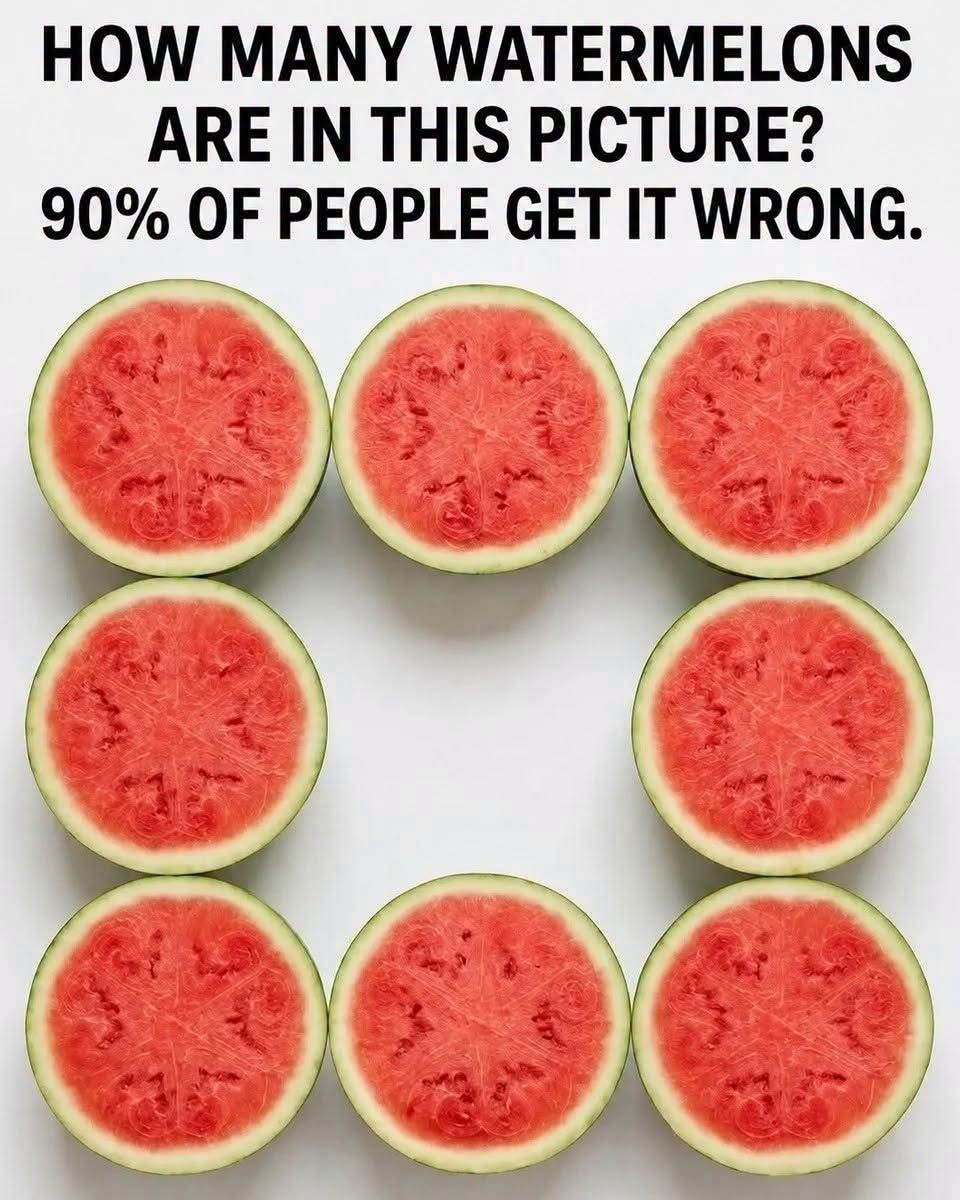
A partial watermelon may still look like a complete fruit at first glance. Once you start examining the image carefully, however, you may notice that certain pieces are missing or that separate sections need to be combined.
That is where the puzzle becomes more challenging.
The Best Way to Count the Watermelons
Instead of trying to solve the puzzle as quickly as possible, use a systematic approach.
Start by identifying the complete watermelons. Count those separately before considering any partial pieces.
Next, examine the remaining sections.
Ask yourself:
- Is this a complete watermelon?
- Is only part of the fruit visible?
- Does another partial section belong to the same fruit?
- Is any part of the image overlapping another object?
- Has the image been cropped or changed from the original version?
Once the individual pieces have been identified, you can calculate their combined value.
For example, two halves would equal one whole watermelon, while four quarters would also equal one whole. The important part is making sure that each piece is counted only once.
Why Viral Picture Puzzles Create Different Answers
One reason these puzzles can produce different answers online is that images are frequently reposted, resized, cropped, or edited.
A small change to the original picture can alter the number of visible pieces.
This means that before comparing your answer with someone else’s, it is worth checking whether you are both looking at exactly the same version of the image.
Image quality can also make a difference. A blurry or compressed picture may hide boundaries that are easy to see in a higher-quality version.
It’s More About Observation Than Mathematics
Although the final calculation may involve simple fractions, the real challenge is recognizing what you are looking at.
Our brains are remarkably efficient at grouping shapes into familiar objects. This allows us to process visual information quickly, but it can also lead us to make assumptions before examining every detail.
That’s why slowing down can be surprisingly effective.
Rather than asking, “How many watermelons do I see?”, try asking, “How many complete fruits and partial pieces are actually visible?”
That small change in approach can make the puzzle much easier.
A Simple Strategy for Visual Puzzles
The same technique can be useful with many other picture puzzles.
1. Divide the image into sections.
Work from left to right or top to bottom so you don’t accidentally skip an area.
2. Count complete objects first.
Keep a separate mental or written total.
3. Examine partial objects.
Determine whether they represent halves, quarters, or other portions.
4. Watch for overlaps.
One shape may hide part of another.
5. Check the image carefully.
Make sure you are working from the original version rather than a cropped or altered repost.
6. Calculate only after identifying everything.
This reduces the chance of counting the same piece twice.
Why People Enjoy These Challenges
Picture puzzles are popular because they provide a quick mental challenge that almost anyone can try.
They also encourage people to compare their reasoning with friends and family. Two people can look at the same picture, notice different details, and then explain how they reached their conclusions.
That discussion is often more interesting than simply discovering the final number.
Visual puzzles can also serve as a reminder that our first impression isn’t always the complete picture. Taking a few extra seconds to examine the evidence can sometimes reveal details that are easy to overlook.
The Real Lesson Behind the Puzzle
Whether you solve the watermelon challenge immediately or need several attempts, the most interesting part is the process.
The puzzle encourages a simple habit: don’t rely entirely on your first impression.
Look carefully, separate complete objects from partial ones, check your assumptions, and then work out the answer.
And if your answer differs from someone else’s, compare the reasoning rather than simply comparing the numbers. The most convincing solution is the one that clearly explains how every visible piece was counted.
So, how many watermelons did you find?
Take another careful look before committing to your answer—you may notice something you missed the first time.