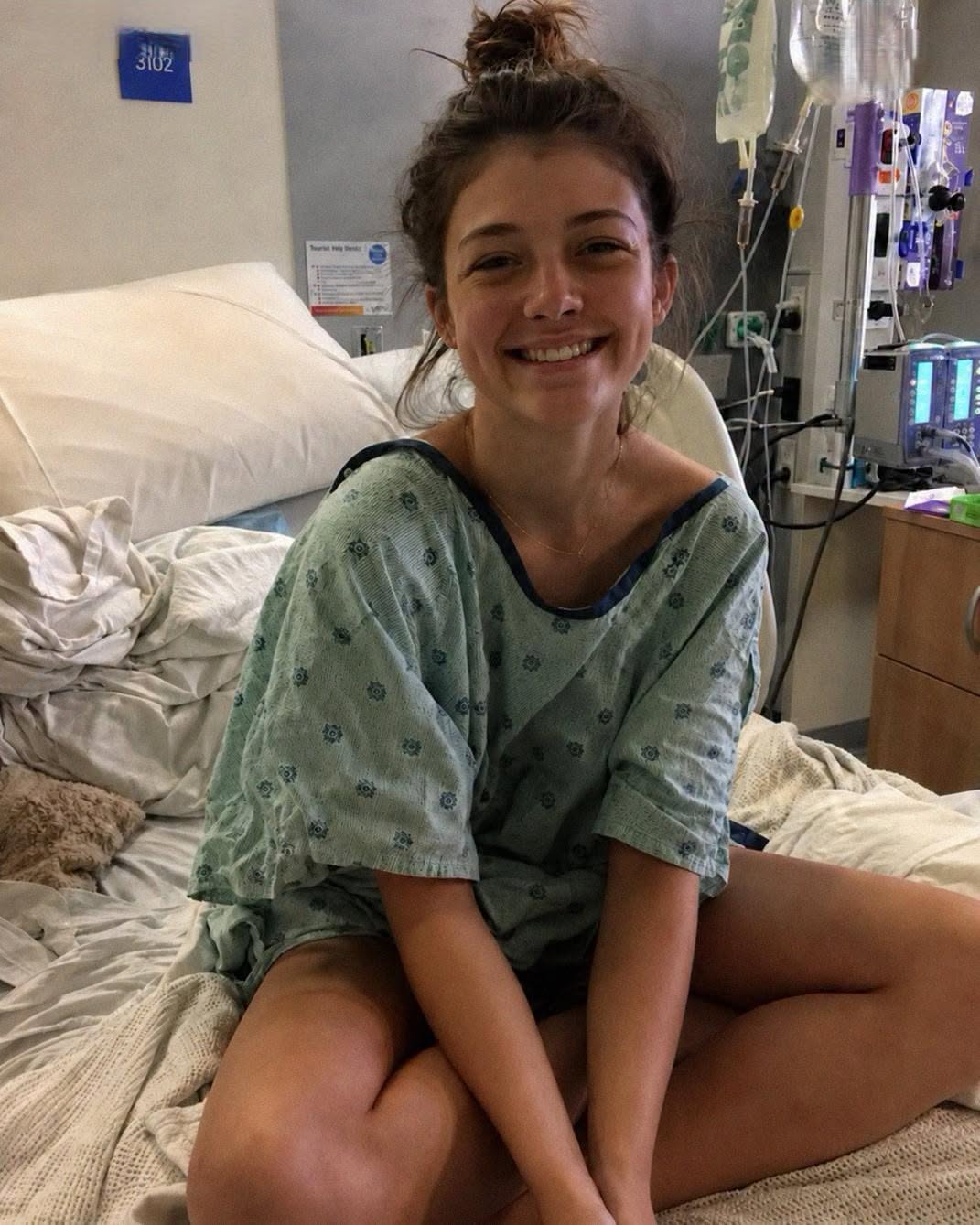
I believed saying goodbye to my 18-year-old daughter would be the hardest moment of my life.
Then, minutes after her honor walk, my husband received a phone call.
I watched the color disappear from his face.
Without explaining where he was going, he hurried down the hospital hallway and vanished around the corner.
I was still trying to understand what had happened when I heard someone calling after me.
“Grace! Please, wait.”
It was Mary’s doctor.
When he finally reached me, he hesitated before saying the words that made my stomach drop.
“Your husband asked me not to tell you something about Mary.”
Mary Had Made One Final Decision
Mary had been seriously ill for almost a year.
Jonathan wasn’t her biological father. He came into our lives when Mary was six, but somewhere along the way, the word “stepfather” stopped describing their relationship.
To Mary, he was simply Dad.
During one of her hospital stays, Mary surprised us with a conversation I wasn’t prepared to have.
“If I don’t make it,” she said quietly, “I want to donate my organs.”
I immediately tried to stop the conversation.
I wanted to talk about treatments. About recovery. About everything we would do when she came home.
Mary wouldn’t let me avoid it.
“If something happens to me and somebody else gets to go home because of it, I want that.”
Jonathan sat quietly beside her.
Then he told her that he supported her decision.
It took me longer.
Eventually, I signed the necessary paperwork with her.
Three weeks later, Mary was gone.
Then My Husband Received That Call
Before the donation procedure, hospital staff gathered for an honor walk.
Doctors and nurses stood silently along the corridor as Mary was taken past them.
I barely remember it.
I remember holding a ribbon.
I remember Jonathan squeezing my hand.
And I remember him whispering, “She did something beautiful.”
Then his phone rang.
He looked at the screen.
Something changed immediately.
“I need to go downstairs,” he said.
“Right now?”
He was already walking away.
That’s when Mary’s doctor came after me.
“Your husband asked me not to tell you the full story,” he said.
“What story?”
He carefully explained that before Mary died, she had asked questions about whether a donation could potentially help a particular person.
I stared at him.
“A particular person?”
He couldn’t discuss another patient’s private medical information.
But suddenly my mind was racing.
Jonathan’s private phone calls.
Conversations that stopped when I entered the room.
And now his sudden disappearance.
“Did Jonathan pressure her into something?”
The doctor shook his head.
“You need to speak with your husband.”
I Found Him With Two Strangers
I eventually found Jonathan on another floor.
He was sitting in a waiting area with a man and woman I’d never seen before.
The woman was crying.
Jonathan saw me approaching and immediately stood.
“Grace…”
“What is happening?”
Nobody answered.
I looked at the couple and then back at my husband.
“Does this have something to do with Mary?”
Jonathan lowered his head.
That was enough.
I demanded the truth.
Instead of answering immediately, he reached inside his jacket and removed a folded piece of paper.
One word was written across the front.
Mom.
It was Mary’s handwriting.
“She wrote this last week,” Jonathan said. “She made me promise I wouldn’t give it to you until afterward.”
I took the letter and walked away.
My Daughter Had Been Keeping a Secret
I found somewhere quiet and unfolded the paper.
Mary explained that during treatment she had become friends with another young patient. I’ll call her Sophie.
Sophie had been waiting for a transplant.
Their friendship had apparently grown much closer than I’d realized.
But Mary had also noticed Sophie’s mother.
She noticed the woman sitting in waiting rooms.
Watching doctors’ expressions.
Waiting for news.
Hoping desperately that her daughter would eventually leave the hospital.
Mary recognized something in her.
She recognized me.
That’s when Mary began asking whether, if circumstances allowed, her decision to become a donor might somehow help Sophie.
And she asked Jonathan to help her find out what was possible.
Why Didn’t She Tell Me?
That was the part that hurt most.
Why had my daughter trusted Jonathan with this but not me?
Then I continued reading.
Mary knew I was still talking about the future as though it were guaranteed.
I constantly said things like, “When you come home…”
“When you’re feeling better…”
“When this is finally over…”
Mary knew those sentences were keeping me together.
She didn’t hide her decision because she loved me less.
She hid it because she didn’t want me spending our remaining time simultaneously hoping she would survive and wondering whether another young woman might benefit if she didn’t.
Near the end of her letter was a sentence I had to read several times.
She couldn’t promise that she would come home with me.
But if things worked out, she hoped she could help another daughter go home with her mother.
And then came one final request.
Please don’t be too angry with Dad. I made him promise.
I couldn’t stop crying.
Jonathan Had Been Carrying the Secret Alone
Eventually, Jonathan found me.
“You should have told me,” I said.
“I know.”
“Then why didn’t you?”
His answer wasn’t complicated.
Mary had spent nearly a year having other people make decisions involving appointments, procedures, medications, and almost every aspect of her life.
This was one decision she desperately wanted to feel was hers.
“She asked me to give her control over this one thing,” Jonathan said. “How was I supposed to take that away from her?”
Then I asked about the couple upstairs.
They were Sophie’s parents.
“And Sophie?”
“In surgery.”
I couldn’t speak for several seconds.
“Because of Mary?”
Jonathan was careful with his answer. There were medical and privacy rules surrounding the process, and he wasn’t going to claim something we hadn’t been officially told.
But there was clearly more to the story than I’d known.
“I want to meet them,” I finally said.
Sophie’s Mother Apologized to Me
When we returned, Sophie’s mother stood.
Her name was Ellen.
The first thing she did was apologize.
“I’m so sorry.”
I didn’t understand.
“For what?”
“For feeling happy today,” she said. “I know what kind of day this is for you.”
That sentence nearly broke me.
Then I noticed the way she was holding herself.
The untouched drink beside her.
Her fingers nervously turning the hospital wristband around her wrist.
I suddenly understood what Mary had seen.
This woman was doing exactly what I’d done for months.
Waiting for somebody to walk through a hospital door and give her permission to hope.
“You don’t need to apologize for wanting your daughter to live,” I told her.
Ellen started crying again.
Then She Told Me Something About Mary
I asked how well the girls had known each other.
Ellen smiled.
Apparently, much better than either of us realized.
She told me that the girls had once been laughing so loudly together that a nurse had to remind them other patients were trying to sleep.
And for a few precious minutes, the conversation wasn’t about illness.
Nobody was talking about Mary as a patient.
Nobody was talking about donation.
They were talking about my daughter as the funny 18-year-old girl she had always been.
Ellen told me Mary talked about me constantly.
She joked that I worried too much.
That I tried to hide when I cried.
And that whenever she became frightened, she thought about going home.
That was when another realization hit me.
Mary had been scared too.
She had simply spent much of her remaining strength trying to protect me from knowing exactly how scared she was.
Then a Nurse Appeared
Eventually, a nurse entered the waiting area with news.
Sophie’s surgery was over.
She was stable.
Ellen’s entire body seemed to release months of tension at once.
She started crying and laughing at the same time.
Then she looked at me, and almost immediately the relief on her face became guilt.
“Go,” I told her.
She hesitated.
“Go see your daughter.”
She stepped toward me uncertainly, so I hugged her first.
“Thank you,” she whispered.
I shook my head.
“This wasn’t my decision.”
I held Mary’s letter against my chest.
“It was hers.”
Ellen promised that her family would remember Mary.
That promise hurt more than I expected.
But somehow, it comforted me too.
I Was Still Angry With My Husband
Jonathan and I remained in the hallway after they left.
“I haven’t completely forgiven you,” I told him.
“I understand.”
“I don’t know what I would’ve done if Mary had asked me to keep something like this from you.”
“I know.”
But I also understood something I hadn’t understood an hour earlier.
Jonathan hadn’t kept the secret because he wanted to deceive me.
He had been honoring a promise to the girl he had raised since she was six.
A girl who called him Dad.
I took his hand.
It wasn’t complete forgiveness.
But it was a beginning.
What Mary Left Behind
Nothing could make losing my daughter easier.
Another family’s happiness couldn’t erase my grief, and I didn’t want it to.
Mary was still gone.
Her room would still be empty.
There would still be birthdays she wouldn’t celebrate and ordinary mornings when I’d instinctively think about calling her.
But Mary had understood something before I did.
She couldn’t control what was happening to her.
She could still have a voice in what she wanted to leave behind.
Somewhere else in that hospital, another mother was sitting beside her daughter’s bed and beginning to imagine the future again.
She could make plans.
She could talk about going home.
Those were the same plans I’d continued making for Mary until the very end.
My daughter couldn’t come home with me.
But in the final chapter of her life, she hoped another daughter might have the chance to go home with hers.
Note: This is a fictional story created for storytelling and entertainment purposes. Names, characters, dialogue, medical circumstances, and events are fictionalized. Organ donation and transplant decisions involve complex medical, ethical, legal, privacy, and allocation requirements that vary by jurisdiction. This story should not be interpreted as describing how a specific real-world transplant would be arranged.