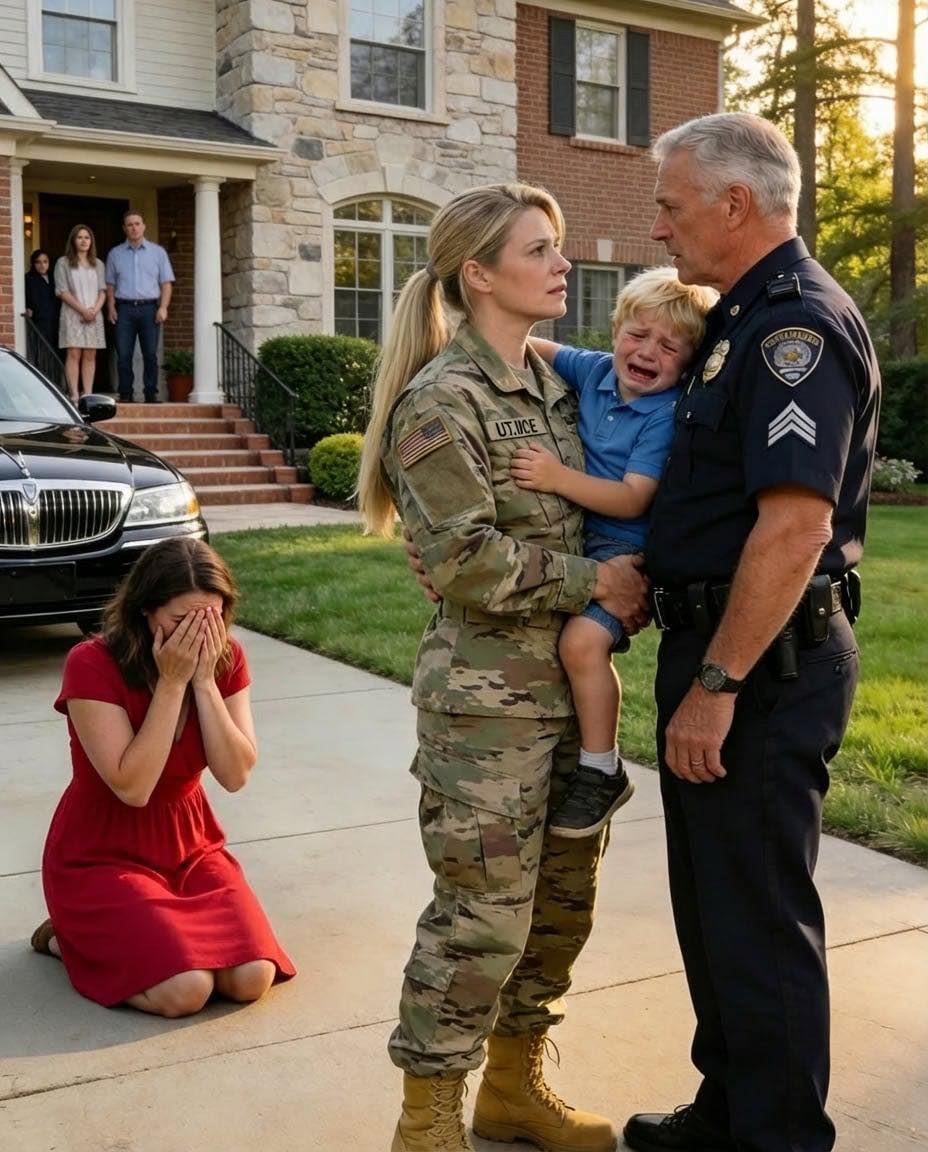
That day was supposed to be another ordinary weekend barbecue—kids running around, adults clustered near the grill, conversations overlapping. Normal noise. Normal chaos.
My son, Eli, was playing near the patio with the other kids. He was close enough for me to keep an eye on him without hovering. He was laughing—chasing bubbles, carefree, safe.
Then in a few seconds, everything went wrong.
A Split-Second Accident Turned Into an Emergency
Eli screamed.
I turned and saw him on the ground near the grill, curled up and crying in a way no parent ever forgets. A metal skewer had shifted. Hot coals had scattered. His arm was burned—badly.
I moved before anyone else even fully understood what happened.
“Get water!” I ordered, already kneeling beside him.
His body trembled, eyes wide with fear, skin turning red fast. I kept my voice steady even though my chest felt like it was folding in on itself.
“I’ve got you,” I told him, holding him close while I assessed the damage and controlled his movement so the injury wouldn’t worsen.
That’s when Lisa’s voice sliced through the panic—sharp, irritated, and somehow more annoyed than concerned.
“Oh my God, this is such a mess,” she said. “Why wasn’t someone watching him?”
I didn’t waste time arguing.
“Call an ambulance,” I told the nearest adult.
But before anyone could move, Lisa stepped in front of me like she was blocking a spotlight from hitting the wrong person.
“Relax,” she said, arms crossed. “It’s just a burn. We don’t need to make a scene.”
I looked up at her, stunned. A child was injured and she was worried about optics.
She rolled her eyes like I was being inconvenient. “Dad’s here. He can handle it.”
When Power and Pride Get in the Way of Medical Care
Her father—the police chief—was already walking toward us. Crisp uniform. Commanding posture. The kind of presence that makes people fall quiet without being asked.
Lisa rushed to frame the situation before he even spoke.
“Minor accident,” she said quickly. “She’s blowing it out of proportion.”
I kept my voice calm, but firm.
“It’s not minor. We need paramedics.”
He hesitated—not because he didn’t understand, but because Lisa had already planted the narrative. And in families like this, the “important” person’s version tends to become the official version.
Lisa got louder, performing for the crowd now.
“You always do this. Everything has to be dramatic,” she snapped.
I stood slowly, Eli still in my arms, keeping his burned arm protected.
Lisa leaned in, lowering her voice just enough to make it personal.
“You don’t get to come into my family and start giving orders like you’re somebody important,” she hissed. “You’re not.”
Her father shifted, caught between his role and his daughter’s entitlement.
I looked him in the eye.
“Chief, I’m asking you one more time—call for medical support.”
Before he could answer, Lisa cut in again.
“Dad, do something. She’s making a scene.”
And then he did what too many people do when they confuse authority with control.
“Ma’am,” he said, trying to sound official, “you need to calm down.”
The Moment I Stopped Staying Quiet
I didn’t want attention. I didn’t want a showdown. But my child was hurt, and the adults around me were treating emergency care like a public relations problem.
So I did the one thing I’d avoided doing for years at family events.
I reached into my bag and pulled out my identification.
The police chief’s posture changed instantly. The confidence drained from his face like someone pulled a plug.
I kept my tone level—professional, controlled.
“You just threatened a senior officer,” I said. “And you’re obstructing medical care for a child.”
Lisa scoffed, still not understanding what was happening.
But her father did.
He turned toward her, voice sharp.
“Be quiet.”
Then he faced me again—smaller now, careful.
I didn’t gloat. I didn’t raise my voice.
“I shouldn’t have to show this,” I said. “The law doesn’t change based on who I am.”
He didn’t argue anymore.
“Call the ambulance,” he ordered immediately, reaching for his radio.
Consequences Arrived Fast
Paramedics arrived within minutes and took over. Eli’s cries softened as they stabilized him, cooled the burn properly, and prepared him for transport.
Behind us, Lisa stood frozen—stunned that her usual shield of influence wasn’t working.
She tried to regain control the only way she knew how: louder, sharper, more frantic.
But this time, nobody rushed to protect her image.
The same authority she’d relied on to intimidate people finally drew a line.
And yes—there were consequences for interfering when a child needed emergency care.
In the Hospital, None of the “Status” Mattered
Doctors treated Eli carefully, wrapping his arm, monitoring him, speaking in calm, honest tones. It would take time, but he was going to be okay.
When he finally woke up, his eyes found mine immediately.
I reached into my bag and pulled out something small I’d been carrying for a long time—a keepsake I didn’t talk about, because some things aren’t meant for conversation.
It was damaged now. The ribbon was gone, burned away. The metal was blackened and scarred from the chaos earlier.
“It’s still here,” I told him softly. “Just like us.”
He gave me the faintest smile and reached for my hand.
His fingers wrapped around mine—weak, but certain.
And in that quiet room, none of the noise from the barbecue mattered anymore. Not the insults. Not the arrogance. Not the power games. Not even the rank I’d kept private for so long.
Because the only thing that mattered was my child—alive, safe, and holding my hand.
Closing CTA: If this story hit home for you, share your thoughts in the comments—have you ever watched someone misuse “status” when what really mattered was doing the right thing?