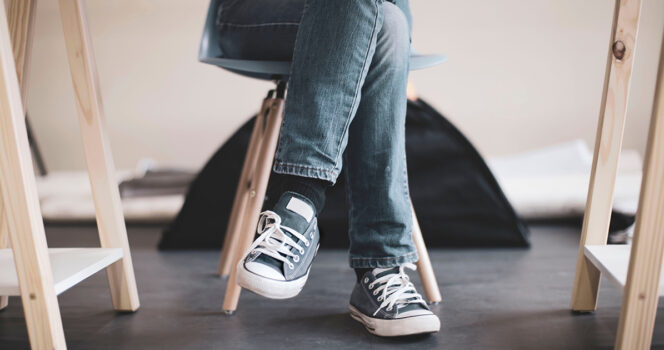
Today, cultural pressure is far less uniform, but the habit remains common—partly because it’s familiar, and partly because it still serves useful social purposes.
The Psychology Behind Crossing Your Legs
Body language specialists often point out that legs and feet can be surprisingly revealing because people tend to monitor their facial expressions more than their lower-body movements. In other words, leg position can sometimes reflect what a person feels before they’ve even put it into words.
One key detail is direction. In many everyday interactions, people naturally angle their legs and feet toward what feels welcoming or interesting—and shift away from what feels uncomfortable. It’s not a hard rule, but it can be a helpful clue when paired with other signals (facial expression, tone, and posture).
Modesty and Practical Comfort (Especially With Certain Outfits)
Fashion isn’t always designed for maximum ease of movement. With skirts or dresses, crossing the legs can be a practical, almost automatic way to feel more secure and maintain modesty—particularly in public spaces, on public transportation, or in professional environments.
Even with more flexible modern clothing, many people keep the habit because it feels “neat,” familiar, or simply more comfortable than sitting with legs apart for long periods.
Leg-Crossing as a Self-Soothing “Boundary”
Psychology also links certain closed postures—like crossing legs or folding arms—to self-comfort. This doesn’t always mean someone is upset or defensive. Often, it’s just a subtle way to create a sense of personal space, especially when:
- the environment feels crowded
- the situation is unfamiliar
- someone is focusing deeply (meetings, interviews, waiting rooms)
Think of it as a quiet, physical way of saying: “I’m settled here.”
What Leg-Crossing Can Signal in Different Situations
1) In the Workplace: Confidence, Control, or Stress Signals
In offices, interviews, and meetings, leg-crossing is common and often reads as composed and self-assured. A neat ankle-cross or knee-cross can project professionalism—especially when paired with relaxed shoulders and steady eye contact.
That said, constant re-crossing, foot bouncing, or tense posture can suggest nervous energy or impatience. The difference is usually in the overall body: relaxed vs. restless.
Some people use a more expansive posture (like resting one ankle over the opposite knee). This can come across as more assertive and space-claiming. When women choose that position, it may signal extra confidence—or simply comfort in a familiar setting.
2) With Friends: Comfort Over “Perfect Posture”
In casual settings, leg-crossing often becomes less polished and more practical. People shift positions, lean back, and sit however feels easiest. Here, the gesture tends to signal ease rather than formality.
3) On Dates: Interest, Attention, and Subtle Flirtation
In dating situations, leg position can become part of the overall “engagement” picture. Crossing toward someone may indicate interest or attentiveness, especially if the torso and feet also angle in their direction.
Slow, deliberate movements—like uncrossing and re-crossing—can sometimes be read as playful or flirtatious, but context matters. The most reliable signs of interest still come from clusters of cues: smiling, eye contact, leaning in, and active listening.
The Bottom Line: It’s Not “One Meaning,” It’s a Whole Context
Women cross their legs for many reasons: comfort, habit, modesty, warmth, confidence, or the need to feel grounded in a busy space. Sometimes it’s social signaling. Sometimes it’s just a better way to sit.
What makes leg-crossing so interesting is that it can be both ordinary and expressive—personality in motion, shaped by culture, setting, and mood.
Enjoy decoding body language? Share this article with a friend and tell us in the comments: do you cross your legs for comfort, confidence, or something else entirely?