
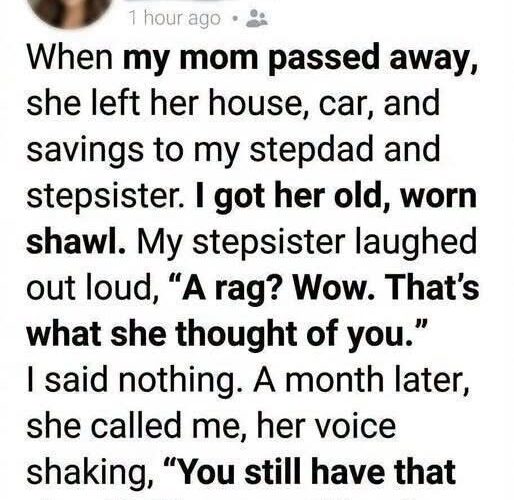

It was faded in places and showed years of wear. My stepsister looked at it and laughed.
“That’s all you got?” she asked.
Someone else might have been angry.
I was simply hurt.
The One Thing I Couldn’t Let Go Of
I took the shawl home and placed it carefully in my living room.
For several weeks, I couldn’t decide what to do with it.
It wasn’t expensive.
It wasn’t particularly beautiful.
But my mother had worn it countless times.
Whenever I looked at it, I remembered sitting beside her while we talked over tea. I remembered cold evenings when she would wrap the shawl around her shoulders and tell me stories about our family.
So I kept it.
Not because it was valuable.
Because it was hers.
Then the Phone Rang
One evening, my phone suddenly rang.
It was my stepsister.
Her voice sounded completely different from the last time we’d spoken.
“Do you still have Mom’s shawl?” she asked.
I was surprised by the question.
“Yes. Why?”
There was a long pause.
Then she said something I wasn’t expecting.
“Please don’t get rid of it.”
I sat down.
“What happened?”
She explained that while going through some of our mother’s documents, she had discovered a handwritten note referring to the shawl.
According to the note, there was something sewn into the lining.
I immediately thought there had to be some mistake.
My mother had owned that shawl for years. I had never noticed anything unusual about it.
A Hidden Pocket
I carefully examined the fabric.
After looking closely, I noticed a section of stitching that didn’t quite match the rest.
With great care, I opened a small part of the seam.
Inside was a tiny hidden pocket.
My hands were shaking as I reached inside.
There were several items wrapped in cloth.
Among them were a few old family keepsakes, including my grandmother’s wedding ring and several coins that had been passed down through the family.
But the item that mattered most was a handwritten letter.
It was from my mother.
The Message She Left Behind
The letter explained why she had chosen the shawl for me.
She wrote that the financial assets she left to other family members were intended to provide practical security.
But the items inside the shawl were different.
They represented our family’s history.
She wanted them to remain with someone who would understand that their importance wasn’t simply financial.
Then she wrote a sentence I will never forget:
“Some things are valuable because of what they are. Others are valuable because of what they mean.”
I read the letter several times.
Suddenly, the old shawl didn’t seem ordinary anymore.
It was a connection to people who had come before me.
Everything Looked Different
My stepsister later asked whether I would consider selling some of the items.
I understood why she asked.
Some of the objects had financial value, and selling them would have been easy.
But I couldn’t do it.
The ring belonged to my grandmother.
The letter belonged to my mother.
And the shawl had become a reminder of both of them.
I decided to keep the collection together.
The Inheritance No One Expected
For a while, I had believed that my mother had left me the least important thing she owned.
I had compared my inheritance with everyone else’s.
The house.
The money.
The valuable possessions.
And the old shawl.
But eventually I realized I had been looking at the wrong thing.
My mother hadn’t simply given me a piece of worn fabric.
She had entrusted me with a piece of our family’s story.
The shawl became something I could pass down one day and explain to another generation.
“This belonged to your great-grandmother,” I could say.
And then I could tell them the story.
Some Things Can’t Be Measured
Losing my mother was painful enough.
For a while, I also felt forgotten because of the way her belongings had been divided.
But that hidden pocket changed how I understood her final gift.
The most meaningful inheritance isn’t always the most expensive one.
Sometimes it’s a photograph.
A handwritten recipe.
A piece of jewelry.
An old letter.
Or a worn shawl that carries memories no price tag can measure.
I still have the shawl.
And whenever I see it, I no longer think about what I didn’t inherit.
I think about what my mother trusted me to remember.
Some family treasures aren’t valuable because they can be sold. They’re valuable because they help keep someone’s story alive.