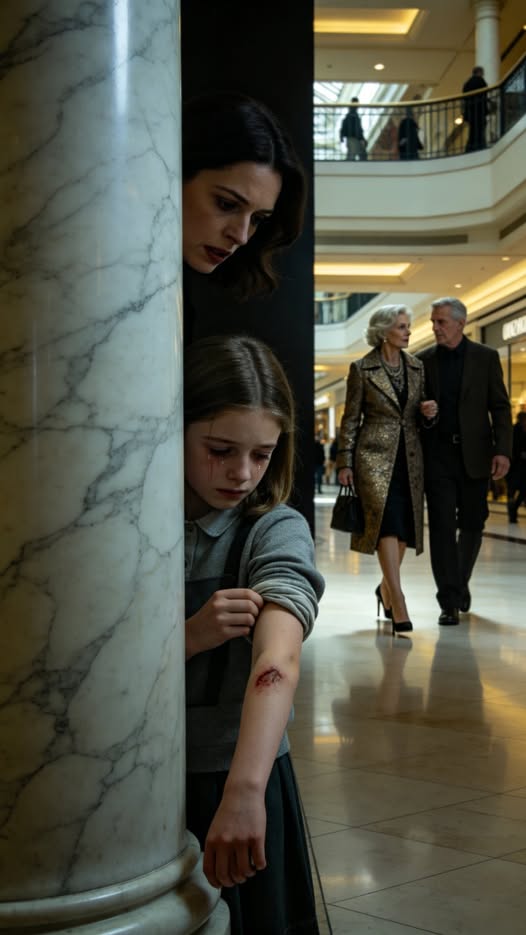
Black Friday at the Mall of America isn’t just busy—it’s a full-body assault on the senses. The entire place feels like a living organism fueled by pure chaos: crowds colliding shoulder to shoulder, shopping bags smacking legs as people speed-walk past, children shrieking from sugar and overstimulation, and the air thick with cinnamon pretzels mixed with designer perfume. If you’re searching for calm, this is the worst possible place to go.
But if you want to blend in and vanish completely?
There’s nowhere better.
That’s why it took me a second to notice my daughter’s sudden panic.
Lily, only eleven, clamped onto my hand so tightly her fingers hurt. Before I could even ask what was wrong, she dragged me behind a fake marble column near the rotunda. Her breathing was shallow and shaky—the kind that doesn’t come from being tired, but from being terrified.
“Mom,” she whispered, barely audible. “Don’t move. Please.”
My first instinct was to think she’d spotted a fight, or maybe gotten separated from me for a second and panicked. I leaned out just slightly to see what she was staring at.
And my brain almost refused to process what I saw.
Walking confidently past the Sephora entrance was my husband, Ethan.
And hanging on his arm—close, familiar, almost possessive—was Doris.
My mother-in-law.
Except the Doris I knew had spent the last three weeks in my house moving slowly with a walker, claiming she couldn’t remember basic things like whether she’d eaten lunch. The woman in front of me looked like an entirely different person.
She was wearing sleek three-inch heels. Her hair was styled in a glossy blowout that caught the overhead lights perfectly. She had on a fitted camel coat like something out of a fashion magazine, and she was laughing—openly, freely, like she didn’t have a care in the world.
I’d never heard that laugh in my home.
“That’s her,” Lily muttered, her voice sharp with anger. “Look at her, Mom. She doesn’t even need the walker.”
That morning Ethan had texted me:
Taking Mom to the clinic. Bad day. Brain fog is really heavy.
I squeezed Lily’s hand—our silent signal to stay close—and we followed them at a distance through the jewelry wing. Ethan looked relaxed, almost relieved, like he’d finally solved a problem I hadn’t even known existed.
At a kiosk, Doris held up her wrist while someone showed her a bracelet. I noticed her nails immediately—fresh crimson polish, glossy like it had just dried.
The same woman who had claimed the smell of nail polish gave her migraines.
Then Ethan placed his hand on her lower back, guiding her toward Nordstrom.
That touch wasn’t protective.
It wasn’t respectful.
It was intimate.
It was the way a man touches a partner—not his elderly mother.
My stomach dropped.
I turned Lily toward me, shielding her face against my coat, and we backed away. We didn’t run. Running makes people look guilty. Running attracts attention.
Instead, we walked quickly and calmly until we reached the parking garage.
Once we were inside the quiet safety of my car with the doors locked, I looked over at Lily.
“Okay,” I said softly. “Tell me everything.”
She stared out the window for a long moment before speaking.
“Grandma Doris told me not to tell you stuff,” Lily finally said. “She said a woman has been coming over when you’re at work. And she said if I told you, you’d be mad at Dad.”
My chest tightened.
“And sometimes,” Lily continued, “when you’re not home, she walks normal. No shaking. No slow steps. She stood up straight in the garage once to look at herself in the car window.”
Lily’s voice cracked.
“And when she saw me watching, she grabbed my arm.”
My hands tightened on the steering wheel.
Lily pulled up her sleeve. On her forearm was a faint bruise, yellowing around the edges.
“She told me I needed to respect her,” Lily whispered. “Then she started acting sick again.”
In that moment, the fear in me hardened into something colder.
This wasn’t just a lie.
It was a performance.
And my child was being used as a pawn.
When we got home, I told Lily to act normal. Homework. Dinner. TV. Like we hadn’t seen anything.
A few hours later Ethan walked through the door holding a pharmacy bag like a stage prop.
“Long day,” he sighed, kissing my cheek with the lazy confidence of a man who thought he had control.
From the living room, a weak trembling voice floated out.
“Megan? Sweetheart? Did I already eat today?”
I walked in.
There she was—bundled in oversized sweaters, eyes watery, hands shaking.
The perfect fragile old woman.
“You ate, Doris,” I replied evenly.
And for the next few days, I watched.
I listened.
I took mental notes.
Ethan had been “between jobs” for eight months, yet somehow he always had money for sports betting apps and “business opportunities” he never explained. He kept pushing me to sign a stack of papers: a Durable Power of Attorney, supposedly for Doris’s healthcare.
But something felt off.
So I read every line.
And buried in the paperwork was the real reason.
A clause that would give Ethan access to Lily’s trust fund—$250,000 left to her by her biological father. The centerpiece of it was an antique sapphire-and-diamond bracelet kept in our safe.
I didn’t sign a thing.
Instead, I called an old friend of mine—Detective Jake Miller.
I told him about the mall. About the bruise. About the sudden obsession with paperwork.
Jake didn’t hesitate.
“Megan,” he said, “you need proof. Real proof. Otherwise it’s just a suspicion.”
So I laid bait.
At dinner that night, I casually mentioned that the trust attorneys were sending someone on Friday to pick up the bracelet and place it in a secure vault.
Ethan froze mid-bite.
“Friday?” he asked too quickly. “That’s… soon.”
I smiled like it was nothing.
The next morning, I told Ethan I had a double shift.
Instead, I drove a few blocks away and parked behind a row of bushes where I could see the house.
Then I opened an app on my phone.
The day before, I had installed two small motion-activated cameras—one hidden inside a smoke detector, the other inside a hollowed-out book on the shelf.
At 8:15 AM, the video feed flickered on.
Ethan was pacing with his phone pressed to his ear.
“She’s moving it tomorrow,” he hissed. “We have to grab it today.”
On the couch, “Doris” suddenly stood up.
Straight.
Flexible.
Young.
She tossed the blanket aside like it was nothing, peeled off a gray wig, and then removed what looked like latex pieces from her cheeks.
Underneath was a woman in her thirties.
She rolled her eyes. “God, I hate wearing this thing. It itches.”
Then she laughed.
“Your wife is so annoying, Ethan.”
Ethan smirked. “She’s clueless.”
I hit record.
They walked down the hallway. Ethan opened the closet and spun the safe dial without hesitation. He pulled out the velvet box.
“Bingo,” the woman whispered, her eyes shining. “That bracelet alone is worth at least a quarter-million.”
My hands were shaking as I called Jake.
“They’re doing it. Right now.”
I drove home fast and pulled into the driveway just as Ethan and the woman stepped outside.
Ethan stopped dead, his face twisting into forced confusion.
“Meg?” he said. “I thought you were working.”
“Forgot my laptop,” I said calmly as I stepped out. “Where are you going?”
Ethan forced a laugh. “Just… taking Mom out for some fresh air.”
Beside him, Vanessa—because that’s who she was—immediately hunched over and grabbed the walker, shaking like she deserved an Oscar.
I tilted my head.
“She looks pretty energetic for someone who can’t stand without help,” I said. “How’s the hip today, Doris?”
Ethan’s smile cracked.
Then blue lights lit up the driveway.
Unmarked police vehicles pulled in fast.
Jake stepped out, calm and grim. He looked straight at Vanessa.
“You can stop acting,” he said. “We have everything on video.”
Vanessa dropped the walker. It clattered loudly against the pavement.
She stood tall, expression turning sharp and cold.
“It was his plan,” she snapped immediately.
I turned to Ethan, my voice quiet.
“Where’s your real mother?”
Vanessa answered before he could.
“Nursing home in Arizona,” she said with a cruel smile. “He hasn’t paid the bill in months.”
Ethan started crying as officers pinned him against the hood of my car, mumbling excuses about doing it “for the family.”
But it was too late.
Fraud. Theft. Conspiracy.
All of it exposed.
The divorce wasn’t just painful—it was an excavation.
My lawyer uncovered gambling debts, unpaid loans, and credit cards opened under my name. Vanessa wasn’t some stranger—she was Ethan’s old college girlfriend. The plan was simple: drain Lily’s trust, sell the bracelet, disappear.
They just didn’t expect me to notice.
And they definitely didn’t expect Lily to see through them first.
Six months later, the house felt different.
Not silent in a scary way.
Silent in a peaceful way.
Ethan and Vanessa were in prison, and Lily’s bracelet was locked in a bank vault so secure it might as well be buried under concrete. The real Doris was located, safe but neglected, and finally placed under proper care.
And I learned something that I’ll never forget:
Trust is not automatic.
It’s earned.
Because sometimes the biggest danger isn’t a stranger breaking into your life—
It’s someone already living inside it.
Especially when they’re wearing heels on a day they’re supposed to need a walker.