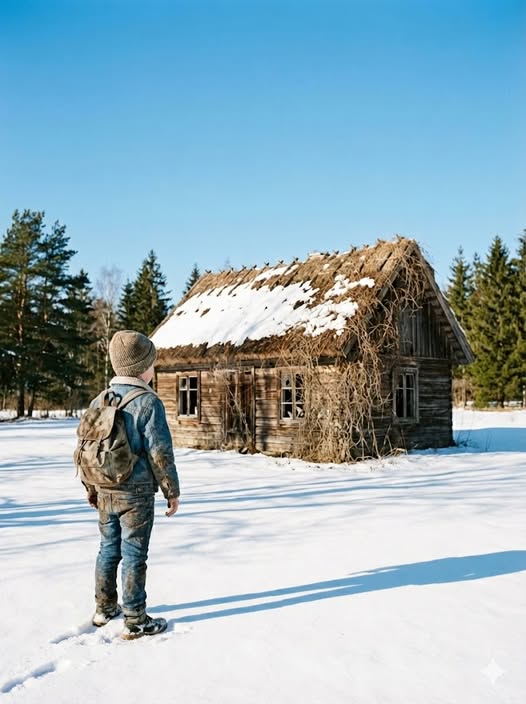
Tommy Reed didn’t wake up to cake or candles on his fourteenth birthday.
There were no decorations taped to the walls, no friends knocking at the door. Instead, the day ended with him standing at the edge of a driveway, a faded backpack on his shoulders and twelve dollars folded in his jeans pocket.
His stepfather’s message had been blunt: leave. His mother stood nearby but offered no protest. When the front door shut, it carried a finality heavier than the sound itself. It wasn’t just a house closing behind him—it was the last fragile sense of safety he’d known.
That afternoon marked the end of childhood.
He walked without direction at first, passing tidy homes glowing with dinner lights and laughter drifting through open windows. The contrast was sharp. As he kept moving, the streets shifted from suburban comfort to cracked pavement and silent warehouses.
That was where he saw it.
A small, battered house leaning slightly to one side, windows broken, paint peeling in long strips. A city notice was stapled crookedly to a post out front. The property, it read, could be transferred for five dollars.
To most people, it was an eyesore. The roof sagged. The yard was a mess of weeds. The door looked like it would fall apart with a strong gust of wind.
To Tommy, it was possibility.
The following morning, he stood inside City Hall, clutching five wrinkled bills. The employees behind the counter exchanged puzzled looks at the sight of a teenage boy asking about a condemned property.
“Are your parents aware?” one clerk asked.
He nodded without hesitation.
There was no regulation stopping him. By the end of the day, a simple deed with his name printed across it rested in his hands. He walked out seven dollars poorer and infinitely richer in determination.
The First Year: Making It Livable
Ownership didn’t mean comfort.
Rain seeped through the damaged roof. Wind slid through cracks in the siding. The floors were uneven, and the smell of damp wood lingered constantly. Tommy chose the driest corner to sleep in, wrapping himself in old blankets he’d scavenged.
Days were spent hauling debris outside, nailing boards over shattered windows, and teaching himself repairs through trial and error. His early attempts were rough—crooked nails, paint splashed where it didn’t belong—but improvement came with repetition.
He wasn’t motivated by pride.
He was motivated by survival.
Every patch in the roof meant fewer sleepless nights. Every repaired board meant greater stability. Bit by bit, the house shifted from ruin to refuge.
Guidance Finds Him
Eventually, people noticed.
His school counselor, Mrs. Patterson, learned about his living situation. Instead of immediately stripping away his independence, she chose a different approach. She connected him with vocational classes that taught practical trades—carpentry, plumbing, and basic wiring.
An older neighbor, Mr. Jenkins, began stopping by in the evenings. At first, he simply observed. Later, he brought tools and instruction.
“Measure twice,” he’d say quietly.
Tommy absorbed everything. Each new skill strengthened both the structure and his confidence.
A Slow Transformation
Over the next several years, steady progress reshaped the house. The roof was replaced. Electrical lines were updated. Plumbing ran reliably. Floors were leveled. Fresh paint brightened the walls.
The building that once looked abandoned became sturdy and welcoming.
At school, Tommy thrived as well. Discipline learned through manual work translated into academic focus. When classmates asked how he managed to succeed despite everything, his response was simple:
“Sometimes you have to create what other people are given.”
Opening the Door to Others
By twenty, Tommy had achieved something few expected—he became a licensed foster parent in Ohio, one of the youngest at the time.
He welcomed teenage boys who had nowhere else to go. Many arrived angry or withdrawn, carrying labels that followed them from placement to placement.
Tommy didn’t offer grand speeches. He offered structure.
They learned how to fix drywall, how to wire an outlet safely, how to cook a proper meal. They also learned something quieter: that stability is built through consistency.
The once-condemned house filled with life—arguments over chores, laughter from movie nights, photos pinned to walls marking graduations and first jobs.
What Five Dollars Really Bought
Years later, the property’s value climbed well into six figures. When asked about the original five-dollar purchase, Tommy never spoke about profit.
“It wasn’t about money,” he would explain. “It was about taking action when no one expected me to.”
One afternoon, he met a foster teen named Caleb who reminded him of himself at fourteen—uncertain and defensive. Tommy handed him five dollars and said:
“Big things grow from small starts. What matters is what you build next.”
More Than a House
The structure itself was never the true achievement.
Its real value lay in the people it supported.
Every young man who left carried skills, confidence, and proof that circumstances don’t dictate destiny. The home became evidence that steady effort can reshape not only wood and brick, but lives.
Tommy’s journey highlights something essential: resilience rarely makes noise. It shows up daily, works quietly, and refuses to quit.
The Lasting Impact
Being pushed out at fourteen could have defined his future. Instead, it ignited it.
A neglected building became a training ground for independence. Hardship became education. Isolation eventually turned into community.
Tommy Reed’s life demonstrates that strength doesn’t always announce itself. Sometimes it begins with five dollars, a broken roof, and the decision to keep going.
Not every act of courage is dramatic.
Some of it simply keeps showing up, hammer in hand, building something better than what was left behind.