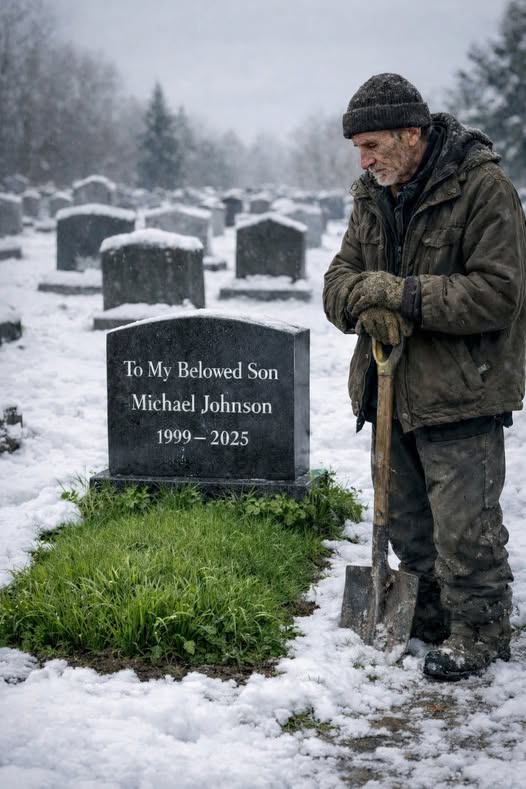
Winter didn’t simply visit Willowbrook Cemetery—it took possession of it. By January, the soil hardened into something closer to stone than earth, and the lawns faded into a lifeless shade of straw. Thomas Hartwell had tended these grounds for thirty-three years. He knew every slope, every drainage flaw, every place where shadows lingered too long in spring. He had witnessed grief in all its forms—widowers whispering to marble, mothers leaving stuffed animals to dissolve in the rain.
Nothing surprised him anymore.
Except Section C, Plot 47.
The marker itself was unremarkable: gray granite, clean lettering. Marcus James Whitman, 1999–2025. Twenty-six years old. A life halted mid-stride. But what unsettled Thomas wasn’t the name or the dates. It was the grass.
While the winter of 2026 buried the rest of Willowbrook beneath snow and subzero winds, that single plot remained vividly green. Not just uncovered—but thriving. Thick blades pushed upward as if it were April. The color was almost aggressive against the white wasteland surrounding it.
One morning, Thomas stepped close, his boots grinding frost into powder. He removed his glove and pressed his palm to the turf.
It was warm.
Not merely thawed—warm, as though something beneath the soil pulsed gently with heat.
Thomas believed in drainage systems, not miracles. His first assumption was technology. Wealthy families had tried stranger memorials before—solar lanterns, motion-sensor tributes—but this was far more elaborate. For several dawns in a row, he kept watch from a distance, expecting to catch a maintenance truck or grieving relative hauling equipment.
No one came.
Snow remained undisturbed. No tracks. No evidence. The warmth seemed to originate from below, steady and internal.
On the fifth morning, curiosity overcame policy. Armed with a spade, Thomas dug.
The shovel slid through the soil effortlessly. There was no frost barrier here. A few feet down, the metal blade struck something solid with a clean metallic ring. Clearing away dirt, he uncovered a sealed black box—industrial, weatherproof. A thick electrical cable ran from it underground, disappearing toward the old stone chapel at the cemetery’s center.
Thomas leaned back, breath fogging the air.
It wasn’t divine intervention.
It was wiring.
Following the buried line, he found a concealed junction behind overgrown holly near the chapel wall. One breaker switch bore a neat label: “C-47.”
Someone had heated a grave.
The explanation arrived days later. At dawn, Thomas spotted a tall, thin man standing over the emerald patch. He wore a worn wool coat and carried himself with the fragile stiffness of someone shaped by loss.
“Mr. Whitman?” Thomas called.
The man turned slowly. His face was lined with fatigue, but his gaze was steady. “You located the system,” he said quietly.
“I did,” Thomas replied. “It’s thorough work. But cemeteries aren’t designed for radiant heating.”
David Whitman stepped carefully along the edge of the grass. “Marcus hated winter,” he said. “From the time he was small, the cold changed him. He called it the ‘season of bone.’ Said it made everything feel empty.”
His voice thinned. “He died just before spring. I couldn’t let him lie here in frozen ground. I know it doesn’t make sense. I know he doesn’t feel it. But when I see this patch alive… I can believe he’s still in warmth.”
He admitted the details plainly: thousands spent on installation, the chapel’s auxiliary line discreetly tapped, a small monthly payment to keep the electric bill unremarkable.
“I’m not trying to break rules,” David added. “I just couldn’t stop being his father.”
Thomas surveyed the endless stretch of white graves behind him. Regulations existed for uniformity—no unauthorized structures, no landscape alterations. Order was part of the job.
But this wasn’t vanity.
It was defiance against cold.
“The system grounded properly?” Thomas asked at last.
David blinked. “Yes. Commercial-grade components.”
“I’ll need the electrician’s name and a diagram,” Thomas said gruffly. “If something shorts during a thaw, I need to know what I’m dealing with.”
Relief overtook David’s expression. “You’re not removing it?”
Thomas looked again at the lone green rectangle glowing against winter’s grip. “As long as I’m caretaker, Plot 47 keeps its spring.”
The rising sun spilled pale gold across the snow. Heat shimmered faintly above the grave, creating a small pocket of air untouched by frost.
Thomas understood something then. His duty wasn’t limited to mowing and maintenance. It was also about preserving the quiet acts of love that refused to surrender to ice.
In time, locals whispered about the grave that never froze. Some called it blessed ground. Others called it strange.
But Thomas knew the truth.
It wasn’t a miracle.
It was a promise kept warm through the winter—powered by grief, wired with devotion, and measured not in volts, but in love.