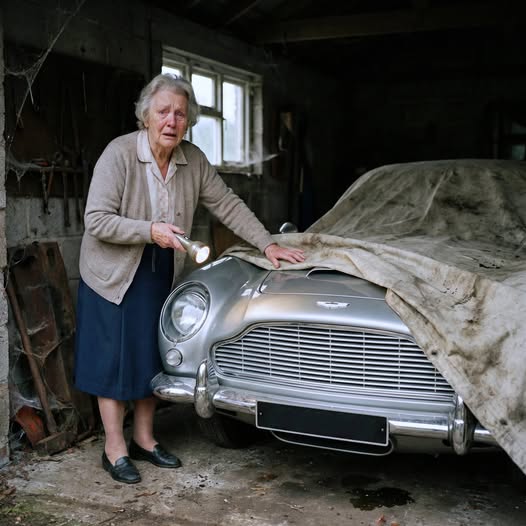
The air inside the building was thick and oppressive, heavy with old grease and the sharp, lifeless scent of dust that hadn’t been stirred in years. I stood there in the darkness, struggling to fit a rough-edged key into the lock while my son’s voice echoed relentlessly in my head.
“You’re pointless, Mom. You wouldn’t know what to do with a real inheritance. Dad understood that.”
The door finally gave way with a dull mechanical clunk. When I pushed it open, the hinges shrieked as though protesting my presence—an echo of the collapse of my forty-two years of marriage. I switched on my flashlight, bracing myself for piles of broken tools and rusted junk. Instead, the beam caught a flash of silver—sleek, deliberate, unmistakably elegant. My breath stopped.
Before I tell you what stood in that room, you need to know how I ended up alone on my birthday, carrying one suitcase and a brass key that felt like a cruel joke after a lifetime devoted to my family.
That morning had started in Mr. Hoffman’s dark-paneled law office. My son, Jonathan, sat across from me, immaculate in his designer suit, confidence radiating from every practiced movement. I felt painfully out of place in the same black dress I’d worn to Robert’s funeral just three weeks earlier.
Mr. Hoffman cleared his throat, discomfort etched into his face. “These instructions were written very deliberately by your husband,” he said. “There is no ambiguity.”
The legal language blurred until the moment everything changed.
“To my son, Jonathan Campbell, I leave the penthouse residence and my primary investment holdings. To my wife, Susan, I leave the property at 1420 Industrial Parkway, including the garage and all contents.”
Jonathan laughed softly. He leaned toward me, gripping my shoulder with a hand that conveyed control, not comfort. “You’ll be fine, Mom,” he whispered. “I’ll make arrangements.”
Those arrangements meant eviction by nightfall. My suitcase landed on the marble floor of the penthouse we’d lived in for fifteen years. “I’m converting Dad’s study into my office,” Jonathan said casually. “You can stay with Aunt Helen—or if you’re feeling adventurous, that garage Dad left you.”
I didn’t go to Helen’s. Fueled by shock and a stubborn surge of pride, I drove straight to the industrial district. To the garage.
Inside, my flashlight revealed three enormous shapes concealed beneath tailored covers. My hands shook as I uncovered the first—an Aston Martin DB5, flawless in silver, its surface gleaming like a sculpture frozen in motion.
The second was a Mercedes 300SL Gullwing, deep blue and impossibly pristine. The third—a Ferrari 275 GTB/4—radiated a red so rich it felt alive.
I found the light switch. The room flooded with clean white light, revealing epoxy floors, silent security cameras, and precise climate controls. This wasn’t storage—it was a vault. On the wall was an envelope, my name written in Robert’s familiar looping script.
“My dearest Susan,” it began. “If you’re reading this, I’ve already left you something far more important than money—freedom.”
Robert explained everything. His illness. His fear that Jonathan had learned to value power over people. He knew that if he left his estate to me directly, our son would strip it away piece by piece under the guise of ‘helping.’
“The cars alone are worth twelve million,” the letter said. “But they are only the visible part.”
Hidden behind a framed photo of our trip to Venice was a digital safe. Our anniversary opened it. Inside was a leather portfolio containing property deeds—apartments in Seattle, retail spaces in Chicago, and a vineyard in Northern California—all transferred to me through a Living Trust the moment Robert passed.
The final document made me cry: a deed to a small furnished cottage in Carmel-by-the-Sea, where we had once talked about retiring quietly.
That night, I slept in a concealed office within the garage. Robert had stocked it with clothes, shoes, even toiletries—all my size, all untouched. He hadn’t just planned for my survival. He had planned for my dignity.
The next morning, I met Marcus Weatherby, the caretaker Robert had hired years earlier. “Your husband believed in silent value,” Marcus told me. “He wanted you to own things that appreciated quietly while the world underestimated them.”
My phone rang mid-conversation. Jonathan.
“Mom, where are you? The designers are coming at nine. You need to clear out your things.”
“I’ll be there,” I said calmly.
At exactly nine, I stepped back into the penthouse. Jonathan barely looked up from his headset. “Did you sleep in your car?” he scoffed.
“I’m not here to argue,” I said, handing him a slim folder.
He opened it—and went pale. Valuations. Property lists. Trust summaries. Millions upon millions.
“This can’t be right,” he whispered. “We should manage this together. I can help you—”
“No,” I said gently. “You already have what you wanted.”
I picked up my suitcase. “This place suits you perfectly.”
At the elevator, I turned back once more. “Your father gave you status, Jonathan. He gave me a future. And I’ve made sure my estate will never trouble you.”
The doors closed on his silence.
As I drove out of the city toward the ocean, the brass key resting beside me, I understood the depth of Robert’s love. He hadn’t left me revenge. He’d left me choice.
And for the first time in decades, my life belonged entirely to me.