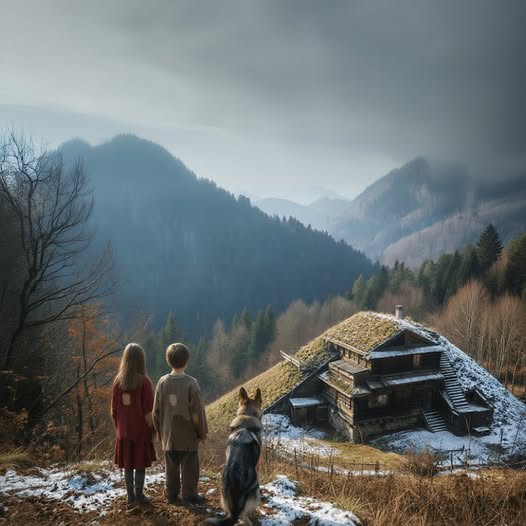
The notice came on a gray Thursday near the end of October, carried up the uneven dirt road outside Asheville by a postal worker unaware that the envelope in his bag marked the end of a family’s last fragile stability. Fourteen-year-old Lily Harper was behind the cabin, splitting damp cedar into thin strips with a worn axe, when her nine-year-old brother Owen ran toward her. He held the envelope carefully, like it might burn him.
“It’s from the county,” he murmured, voice trembling.
Lily didn’t have to open it to guess what it said. Their parents had been gone for three weeks, taken by a slick mountain highway and a shift that never turned into morning. Since then, the cabin had felt hollow. What little money remained had vanished into hospital invoices and burial costs. The landlord had been understanding—but understanding fades quickly when winter creeps into the hills.
The paper inside gave them thirty days. After that, the cabin would no longer be theirs. Owen read the words twice before folding the sheet into a small square. “What are we going to do?”
Lily stared toward the distant Blue Ridge peaks, rising dark and solemn against the autumn sky. She thought of her father’s resin-stained hands and the years he’d spent working the forest trails. “We won’t wait for someone else to decide,” she said, though the certainty in her voice was still new. At her boots, Scout, their scruffy brown mutt, wagged his tail in quiet agreement.
Their choices were narrow and cruel: enter a foster system that would likely separate them, or move to Florida with an aunt who felt more like a stranger than kin. Lily wasn’t trying to be brave—she just knew Owen still reached for her in his sleep. That night, as wind scraped against the cabin walls, she made her decision.
They left before dawn three days later. Their backpacks bulged with canned food, oats, matches, a battered pot, and two heavy blankets. Lily locked the door for the last time and slid the key into the mailbox. Soon the trail grew steeper, the familiar path fading into tangled brush and hidden roots. Owen stumbled more than once, exhaustion shaking his small frame, but Scout circled him faithfully, nudging his hand whenever he slowed.
By noon, their old life looked like a faint blur below the ridges. “What if it’s not there?” Owen asked quietly.
“It has to be near water,” Lily replied. “Dad always said that’s how they built them.”
Late in the afternoon, Scout froze, staring into thick rhododendron. Behind a curtain of pine stood something half-consumed by forest—a weathered cabin. Its timber walls were silvered with age, the metal roof bowed but intact. One shutter dangled loose, exposing a dark interior.
Owen hesitated. “Is someone living there?”
“It doesn’t look like it.” Lily pushed open the protesting door. Dust and old wood filled the air, but the structure felt solid. A broad stone fireplace anchored the room. A narrow ladder climbed to a loft under heavy beams. It wasn’t comfortable—but it was shelter. “We can make this work,” she said.
The first weeks were relentless. Cold air slipped through cracks in the logs. Smoke from their early fires choked the room until Lily figured out how to manage the draft. Days became a rhythm of survival—Owen collecting branches, Lily clearing debris from the chimney. They patched a broken rain barrel with bark and pine sap and uncovered a shallow stone-capped well that offered iron-tasting water.
Food ruled their thoughts. They stretched their supplies carefully, adding what the forest provided. Owen practiced setting simple traps; Lily fished in a narrow creek, hands aching in icy water. Winter wasn’t a season—it was something to endure.
When January arrived, it brought heavy snow and biting silence. The old cabin held. Lily sealed the gaps between logs with moss and mud and kept the hearth burning low and steady, remembering her father’s belief that stone could store warmth.
Then one afternoon, disaster struck. Owen slipped on an icy incline while gathering wood and fell down the ridge. Lily found him shaken and pale, his ankle swelling fast. She dragged him back to the cabin and splinted the injury with carved sticks and strips of cloth. For days she worked alone—chopping wood, hauling water—while Scout lay pressed against Owen, sharing warmth.
During those quiet days, Lily discovered a loose board near the hearth. Beneath it was a rusted tin box filled with fragile papers dated 1948—the journals of a former forest ranger named Samuel Harlan. He had written about storms, isolation, and the pride of building something that would last. One sentence stayed with her: If this place shelters you, care for it and leave it better than you found it. They weren’t trespassing, she realized. They were continuing a story.
By early spring, melting snow revealed smoke rising steadily from their chimney. Hikers spotted it from a nearby ridge, and eventually authorities followed the trail. When deputies and a social worker arrived, they didn’t find two helpless children. They found stacked firewood, repaired barrels, and a home shaped by effort.
“You did all this?” the social worker asked, glancing at the splint and the journal pages spread across the table.
“We didn’t take anything,” Lily answered softly. “We just kept it going.”
They couldn’t remain in the wilderness forever. But their determination moved the local community. Instead of disappearing into the system, they were placed with a couple nearby who ran an outdoor learning program. The cabin was preserved as a historic site, with Lily and Owen invited back whenever they wished.
They returned often—not as runaways, but as caretakers. In losing everything, they had discovered something enduring in the mountains: resilience, belonging, and the strength to stand together.