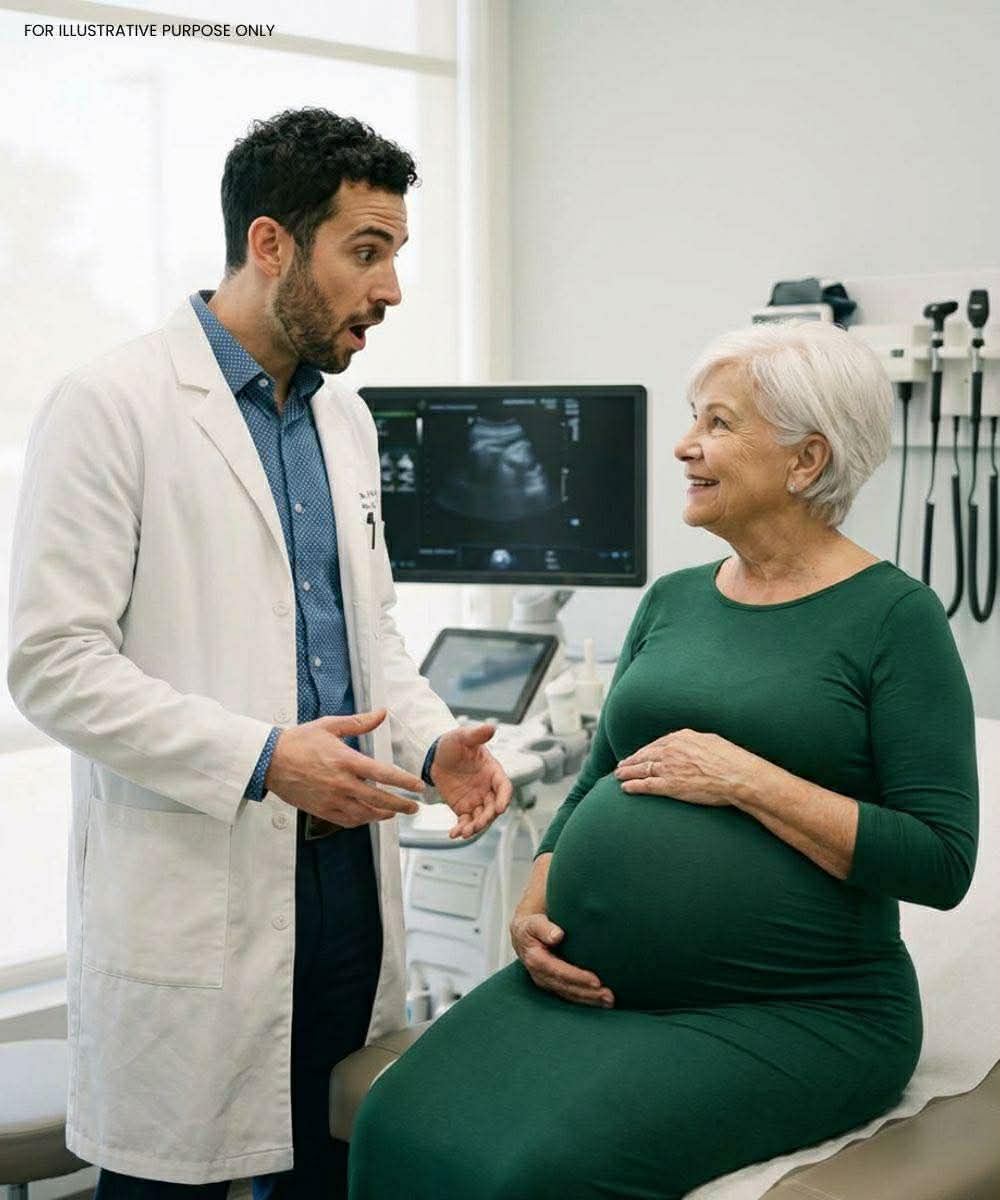
The gynecologist didn’t answer immediately.
Instead, he called for another doctor.
That was the moment fear finally replaced excitement.
Within minutes, a second specialist entered the room. Then a third. None of them spoke much to her directly. They kept studying the screen, pointing quietly, exchanging tense looks.
Larissa’s hands began to tremble.
“Please,” she said softly, “just tell me what’s happening.”
The older doctor finally pulled a chair beside her.
“Larissa,” he began carefully, “you are not pregnant.”
The words hit her harder than she expected.
“But… my stomach… the movement… the pain…”
“We believe there is a very large abdominal mass pressing against your organs.”
Her world stopped.
“A mass?” she whispered.
The doctor nodded gently.
“It appears to be a tumor.”
The room blurred around her.
For months she had imagined holding a child. She had bought baby clothes, chosen names, even prepared a nursery in the spare bedroom. The neighbors who whispered behind curtains no longer embarrassed her because she believed she was living a miracle.
Now, sitting under harsh hospital lights, that miracle collapsed into terror.
Further scans were ordered immediately.
The tests lasted hours.
Doctors eventually confirmed that Larissa had an extremely large ovarian tumor that had slowly expanded over several years. Because of its size and the pressure it created, it caused sensations she had mistaken for movement inside her abdomen.
One surgeon later admitted he had rarely seen anything like it.
“It was compressing several internal organs,” he explained. “That’s why the bloating and discomfort became so severe.”
Larissa barely heard him.
She kept thinking about the tiny knitted socks folded neatly at home.
About the crib.
About how badly she wanted to believe something wonderful was happening to her at the end of her life instead of something frightening.
When her daughter Elena arrived at the hospital that evening, Larissa finally broke down completely.
“I really thought it was a baby,” she cried.
Elena held her hand tightly.
“I know, Mom.”
The surgery was scheduled for the next morning.
Doctors warned the family it would be complicated due to Larissa’s age and the size of the growth. The operation lasted nearly six hours.
Outside the operating room, her children waited in silence.
Finally, the surgeon emerged, exhausted but smiling faintly.
“She’s stable,” he said.
The entire family burst into tears.
The tumor had been successfully removed.
Recovery, however, was not easy.
For weeks Larissa struggled emotionally more than physically. The embarrassment, the confusion, and the grief weighed heavily on her. She avoided phone calls. She packed away the baby items herself one quiet afternoon, folding each tiny blanket with trembling hands.
But slowly, something unexpected happened.
People stopped laughing.
Instead, many began sharing their own stories.
Women wrote to her describing medical conditions they had ignored for years because they were afraid or ashamed. Others admitted they too had mistaken symptoms for something completely different.
Larissa realized she wasn’t foolish.
She was human.
Her doctors later explained that abdominal swelling in older adults can have many causes, and delaying medical care often makes conditions harder to treat.
That realization changed her life.
A year later, Larissa volunteered at a local women’s health center, encouraging others not to ignore unusual symptoms or delay checkups out of fear.
And every now and then, when she opened the closet and saw the small box containing those knitted baby socks, she no longer cried the way she once did.
Because although the miracle she imagined was never real…
surviving was.