Mr. Halvorsen, the farmer who owned the land, watched me from behind the counter.
“You planning on living in that thing?” he asked.
I shrugged. “Planning on not dying.”
He didn’t laugh.
But he signed the scrap of paper that made it mine.
Building Something No One Could Take
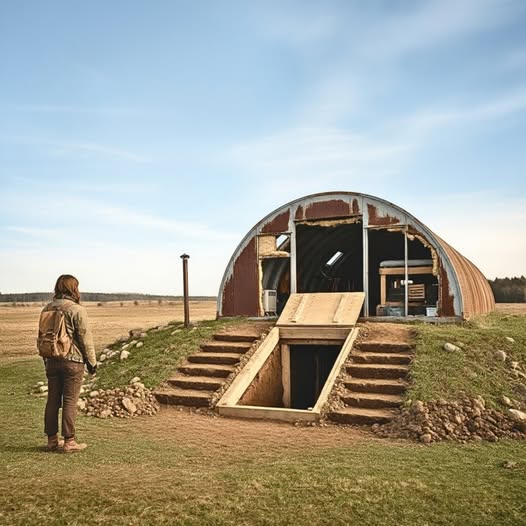
The Quonset hut sat alone at the far edge of Halvorsen’s soybean fields. A curved shell of dented metal ribs, half buried in weeds and wild grass.
To most people it looked like junk.
To me it looked like a chance.
I cleaned it out first. Old raccoon nests. Rusted barrels. A broken chair that looked older than my mother.
Then I started digging.
I didn’t know exactly why. I just knew I needed something safer than thin metal between me and the world.
At first it was just a shallow trench in the dirt floor.
Then it became a hole.
Then a room.
I scavenged everything I could find—old pallets, cinder blocks from a demolition site, scrap plywood tossed behind a construction yard.
Mr. Halvorsen never asked many questions. Sometimes he’d drive past on his tractor and toss a bottle of water or a sandwich onto the ground near the hut.
“Don’t collapse the place,” he’d say.
“I won’t.”
Truth was, I had no idea what I was doing.
But every day the bunker got deeper.
Stronger.
More mine.
The Storm
Three months later the sky turned the color of bruised steel.
Missouri storms roll in fast, but that evening felt different. The wind started screaming across the fields before the rain even arrived.
The radio I’d found at a thrift store crackled with warnings.
Severe thunderstorm. Possible tornado activity.
I shut the Quonset door and climbed down the ladder into the bunker.
The space wasn’t big yet. Just a reinforced pit with wooden beams overhead and dirt walls packed tight.
But it felt solid.
Safer than any place I’d slept since leaving home.
Then the wind hit.
The Quonset hut howled like a wounded animal.
Metal groaned.
Something slammed into the roof with a thunderous bang.
For the first time since starting the bunker, fear crept in.
What if I’d built a coffin?
The storm raged for nearly an hour.
Rain hammered the ground above me. The wind roared so loud it felt like the earth itself was tearing apart.
Then—
Silence.
Slowly, carefully, I climbed the ladder.
When I pushed open the hatch, I froze.
The soybean field was flattened like someone had run a giant hand across it.
Branches and debris were scattered everywhere.
But the Quonset hut…
It was still standing.
Bent.
Scratched.
But standing.
And the bunker beneath it hadn’t moved an inch.
That’s when something clicked in my head.
I hadn’t just built a hiding place.
I had built something strong.
Something that could survive.
The First Visitor
Two days later a pickup truck pulled into the field.
A man stepped out wearing muddy boots and a worried expression.
“You the kid living out here?” he asked.
“Yeah.”
He pointed at the hut.
“Storm took half my barn and my storm cellar flooded. Heard you built something underground.”
I hesitated.
Then I showed him.
When he climbed back up the ladder he looked at me differently.
“How old are you?”
“Seventeen.”
He shook his head slowly.
“You ever think about building these for other people?”
I hadn’t.
But suddenly the idea felt bigger than the Quonset hut.
Bigger than surviving one storm.
Maybe I wasn’t just digging holes in the dirt.
Maybe I was building something that could change my life.
Where It All Began
That winter I built two more bunkers.
Then four.
Then ten.
Farmers. Families. People who had seen what storms could do.
Word spread faster than I could keep up.
And every time I stepped into that first bunker beneath the rusty Quonset hut, I remembered the night everything started.
The night I was told to leave.
The night I thought I had nothing.
Turns out…
Sometimes getting kicked out is just the first step toward building something no one can ever take away from you.