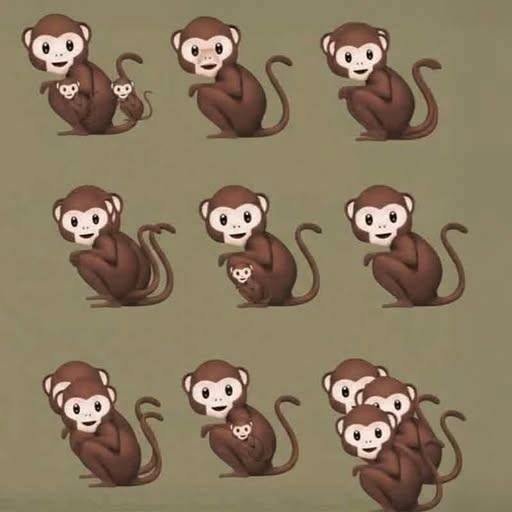
One person sees the forest.
Another notices the individual trees.
Both styles can be useful depending on the situation.
How the Brain Uses Mental Shortcuts
Every second, the brain receives an enormous amount of sensory information.
It cannot examine every sound, shape, movement, texture, and color with equal attention. To function efficiently, it uses mental shortcuts.
These shortcuts help us recognize faces, read words, avoid danger, and understand familiar environments quickly.
They also cause us to overlook information.
When viewing the monkey puzzle, the brain may recognize the most prominent figures and decide that the task is complete.
Once the mind believes it has found the answer, it may stop searching.
This is one reason hidden-image puzzles can be so surprising. When someone points out an overlooked figure, it suddenly becomes obvious.
The detail was visible all along.
The brain simply had not treated it as important.
Does the Puzzle Really Reveal Narcissism?
Despite the dramatic captions commonly attached to these images, counting cartoon monkeys is not a reliable way to identify narcissism.
Narcissistic personality disorder is a complex mental-health condition that cannot be determined through a single visual puzzle or social-media post.
A genuine psychological assessment considers long-term patterns of behavior, relationships, emotional responses, and personal functioning.
It is not based on whether someone notices six monkeys, eight monkeys, or any other number.
The narcissism claim is primarily an engagement tactic.
It creates tension.
People become curious about their own result, concerned about the label, or eager to argue with others in the comments.
That emotional response encourages more likes, shares, and conversations.
The stronger the claim, the more likely people are to interact with the post.
Why Dramatic Personality Claims Spread So Easily
A plain visual puzzle may be mildly entertaining.
A visual puzzle that promises to expose a secret about your personality is much more powerful.
Social-media posts often rely on emotional triggers to gain attention.
They may suggest that only highly intelligent people can solve a puzzle, that one answer indicates loyalty, or that another reveals a troubling personality trait.
These statements are rarely based on serious research.
They are designed to create a reaction.
People want to prove that they are observant.
They want to compare their results.
They want reassurance that their answer places them in a desirable category.
Even disagreement helps the post spread because arguments increase engagement.
The puzzle succeeds not because it provides a meaningful diagnosis, but because it turns a simple image into a personal challenge.
What the Puzzle May Actually Tell You
Although it cannot diagnose a personality disorder, the puzzle may still encourage useful self-reflection.
It can show how quickly you trust your first impression.
It may reveal whether you prefer to understand the overall picture or investigate small details.
It can also demonstrate how easily attention changes perception.
A person who finds only the obvious shapes may naturally prioritize speed and clarity.
Someone who continues searching may enjoy complexity and precision.
But these are not fixed personality categories.
The same person may use different approaches in different situations.
You might quickly scan a road sign while driving, carefully inspect a contract before signing it, and completely overlook a familiar object in your own home.
Attention is flexible.
Context matters.
Why Hidden-Image Puzzles Feel So Satisfying
There is a small moment of excitement when a hidden figure finally becomes visible.
Before noticing it, the shape appears meaningless.
Afterward, it becomes almost impossible not to see.
That sudden shift gives the brain a sense of discovery.
It feels as though the image has revealed a secret.
This reaction is one reason optical illusions and hidden-object puzzles remain popular. They remind us that seeing is an active process.
The brain is constantly making predictions and testing interpretations.
When the interpretation changes, the image can appear to transform even though nothing on the screen has moved.
The Puzzle Can Teach a Lesson About First Impressions
The most valuable lesson may have nothing to do with the number of monkeys.
It may be the realization that first impressions are incomplete.
People often feel confident about what they have seen, heard, or understood.
We make quick judgments about situations, conversations, and other people. Once those judgments are formed, we may stop looking for additional information.
A simple visual puzzle demonstrates how easily important details can be missed.
If the brain can overlook a visible shape in a small cartoon, it can also overlook subtle information in everyday life.
We may miss a change in someone’s mood.
We may misunderstand the meaning behind a comment.
We may ignore an opportunity because it does not match what we expected to find.
Looking again can sometimes change the entire interpretation.
Certainty Can Create Blind Spots
One of the most interesting features of these puzzles is how strongly people defend their answers.
Someone may insist there are only a certain number of figures because that is all they can currently see.
When another person identifies additional shapes, the first reaction may be disbelief.
This is not limited to cartoons.
Human beings often become attached to their interpretations.
Once we believe we understand something, contradictory details can feel inconvenient or even threatening.
The puzzle offers a harmless example of this tendency.
It encourages us to pause before assuming that our perspective is the only possible one.
Another person may not be looking at a different reality.
They may simply be noticing a part of it that escaped our attention.
Why We Love Tests That Promise Simple Answers
Human personality is complicated.
People behave differently depending on their environment, relationships, experiences, and emotional state.
Yet we are repeatedly drawn to tests that reduce this complexity to one quick answer.
Choose a picture.
Count some animals.
Select a color.
Then receive a label.
These tests feel appealing because they offer certainty. They transform something confusing into something simple and easy to share.
However, genuine self-understanding usually requires more than a viral image.
It develops through experience, reflection, honest feedback, and attention to long-term patterns.
A monkey puzzle may begin a conversation, but it cannot define a person.
The Real Reason to Look Again
The next time you encounter one of these viral images, there is no need to worry about what the caption claims your answer means.
Instead, treat it as an exercise in attention.
Look at the obvious figures.
Then examine the spaces between them.
Check the outlines, overlaps, and background details.
Notice whether your interpretation changes when you slow down.
The value is not in reaching a supposedly perfect number.
It is in recognizing how easily the mind settles on an answer before all the information has been considered.
A Small Puzzle With a Larger Message
The monkey image does not expose a hidden narcissist.
It exposes something more ordinary and more universal.
Every person sees the world through a limited field of attention.
We notice some details and miss others.
We interpret information through expectations shaped by experience.
We often assume our first understanding is complete when it is only one possible view.
That should not make us distrust our minds.
It should make us more curious.
The most meaningful response to the puzzle is not asking what your monkey count says about your personality.
It is asking what else might become visible when you take the time to look again.
There is usually more to an image, a situation, or a person than appears at first glance.
Sometimes the difference between missing something and understanding it is simply the willingness to pause for a few more seconds.