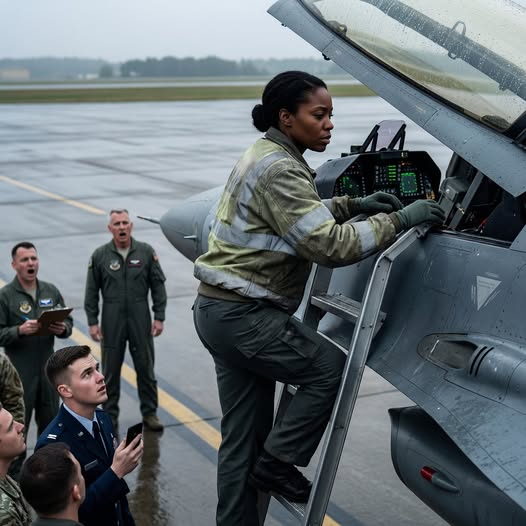
For eight long years, Renee “Rey” Carter drifted through Hawthorne Air Base like a shadow. She was the woman pushing the gray cleaning cart through hangars that smelled of scorched metal and jet fuel. She scrubbed oil stains from concrete floors, emptied trash bins in briefing rooms where strategy was whispered, and polished the glass of the commander’s office until it reflected a world she had been forced to leave behind. To most of the young airmen, she was simply “the Black janitor,” an invisible presence in a uniform of anonymity.
But Captain Tyler Vance saw her differently. To him, Renee was the perfect target for his bored, entitled cruelty. The son of a powerful defense contractor, he believed birthright alone made him untouchable. He mocked her with exaggerated bows, sneered “ma’am” with theatrical contempt, and delighted in the laughter of onlooking officers. That Tuesday, Vance decided to push the joke further.
Renee was wiping down a simulator bay when Vance swaggered in, eyes glinting with malice. Earlier that morning, he had glimpsed a faint tattoo on her forearm—a phoenix emblem, a mark of an elite flight squadron. To him, it was a joke.
“Hey, janitor,” he called across the metal floor. “Think it’s time we see if that pilot ink is real or just a fantasy.”
Colonel Derek Henshaw, head of air operations, appeared nearby. His unreadable face gave Vance the green light. Within minutes, a crowd had formed on the tarmac. An F-16 Fighting Falcon sat ready, canopy open, the cockpit a trap disguised as opportunity.
“Go ahead,” Vance smirked. “Show us what you’ve got.”
Renee’s throat tightened. Eight years had passed since the Air Force had discharged her over a fabricated “security breach.” Once a rising Captain, she had been purged from records, her wings clipped, her career erased.
She stepped up the ladder, and in that instant, the janitor disappeared.
Her hands moved with the fluidity of memory etched into muscle. Checklist items clicked into place with precise rhythm: battery, oxygen, avionics, fuel. Vance’s smirk faded, evaporated.
She keyed the radio, voice calm and clipped. “Hawthorne Ground, Falcon Two-Seven, requesting comm check.”
“Falcon Two-Seven, loud and clear,” the tower responded.
The crowd froze. Colonel Henshaw’s face drained. Then a new voice came through—a commanding, unmistakable authority from High Command.
“Falcon Two-Seven… identify yourself.”
Renee drew a breath that carried the weight of eight years. “This is… Renee Carter.”
Static crackled, then: “Captain Carter. We need to talk.”
Major General Calvin Reddick, a name synonymous with integrity, had bridged the distance between tower and tarmac. As the truth surfaced—that the humiliation tactic had targeted a former officer—the General’s tone hardened.
“Do you still have your credentials number?” he asked.
“AF-19-7743,” she replied without hesitation.
Clicks echoed from the other end. “Still in the archives,” Reddick confirmed. “It was never erased… only hidden.”
Renee’s heart pounded. She glanced at the cockpit panel, then at Henshaw. “I’ve been collecting proof for eight years,” she said. “Every forged signature, every redirected contract.”
Within hours, federal investigators descended on Hawthorne. Renee wasn’t a janitor in Building Six—she was the witness, the architect of exposure. A flash drive she had safeguarded contained a decade of metadata, contractor logs, and the Vance family’s illicit dealings.
Colonel Henshaw stuttered when Special Agent Monica Lane produced an old “temporary suspension” order he had signed—a document with no legal weight. Captain Vance, the instigator, was escorted away, family influence powerless against federal law.
By sunset, footage of Renee running the F-16 checklist went viral. The world saw a woman discarded, cleaning floors for the very people who had stolen her career, yet commanding an aircraft like a legend.
Major General Reddick didn’t just apologize; he restored her record. “Captain Carter,” he said, in a room filled with the top brass, “your status is reinstated. Back pay processed. Flight privileges evaluated. We owe you more than words.”
Renee didn’t seek ceremony. She wanted the sky. A week later, she climbed into the F-16, flight suit pristine, the phoenix patch restored.
“Hawthorne Tower, Falcon Two-Seven, ready for departure.”
“Falcon Two-Seven, cleared for takeoff. Welcome back, Captain.”
The engines roared, the jet rising, the weight of eight stolen years left behind. She didn’t stunt; she mastered. Buried alive and refusing to die, Renee Carter flew not for revenge—but for mastery.
She went further. Using her restored pay and platform, she launched the Phoenix Flight Initiative, an academy empowering women and underrepresented students in aviation. Competence, not privilege, became the loudest voice in the hangars.
No longer polishing glass for others, she soared above it. On the day her first class graduated, a student asked how she survived years of enforced silence.
Renee gazed at the open sky. “The truth doesn’t expire,” she said. “You just have to be ready to fly when the canopy lifts.”