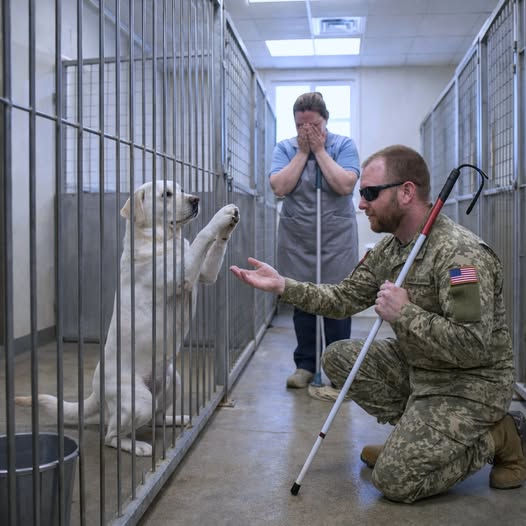
The hollow, rhythmic tap of a white cane echoed through the linoleum corridors long before Ethan Walker emerged into the lobby. He moved with the careful, deliberate grace of someone who had spent years navigating a world without light. His left hand skimmed the cool plaster wall for balance, while his right gripped the cane—his essential guide in a universe of shadows.
Ethan was no stranger to danger. A decorated Army sergeant, he had endured ambushes, night raids, and the deafening chaos of explosions. Yet nothing in the desert had felt as heavy as stepping into the Canine Rehabilitation and Adoption Center. The air here was thick: a mix of disinfectant, cold metal, and the earthy scent of wet fur. It hit him like a wave, signaling a battle unlike any he had faced—a struggle against his own solitude.
His heart pounded, each beat echoing louder than his boots on the polished floor. He wasn’t preparing for combat; he was confronting the emptiness that had followed him home, a silence that lingered in the corners of his apartment like an uninvited guest.
“Mr. Walker?” A gentle voice broke through the hum of his thoughts. Warm, steady, coming from his right. “You made it. Welcome.”
Ethan paused, offering a faint, rehearsed smile. “Please, just call me Ethan.”
“I’m Karen,” she said. “I’ll be guiding you today. We have several calm, well-trained service dogs ready for pairing—Goldens, Labs, exceptional animals trained for guidance.”
Ethan’s fingers tightened around the cane. “I’m not looking for perfection,” he murmured. “Just someone who understands what it means to lose the light.”
As Karen led him deeper, the ambient noise shifted. Barks bounced off steel doors and concrete floors, a chaotic symphony. Ethan didn’t just hear the sounds—he analyzed them. Fear, agitation, loneliness—all resonated within the echoes.
Then came a sharp, jagged snarl that cut through the air. A bark so explosive, it shook the floor beneath his boots. Karen froze.
“That’s Thor,” she said, her voice tense. “One of our more… challenging cases. A retired police dog with severe behavioral issues. He’s in permanent isolation.”
Ethan tilted his head, listening. That guttural growl wasn’t merely aggression—it carried pain, loss, and raw grief. He knew the sound well.
“What happened to him?” he asked, stepping closer despite Karen’s hesitation.
Thor had once been a star among police dogs: expert in tracking, explosives detection, and apprehension. But during a warehouse raid a year ago, an explosion claimed his handler, Officer Daniel Reeves. Thor survived, but when they tried to pull him away, he snapped. Since then, he had lived in a constant state of war, attacking anyone who came near.
The staff recoiled at Ethan’s interest, warning him that Thor was dangerous. But he felt a pull he couldn’t ignore. He knew grief, and he recognized it in the dog’s voice.
“I want to see him,” Ethan said calmly.
The objections were immediate, desperate. “He’ll kill you!” they cried. “Stay back!”
But Ethan ignored them, focusing on the silence that had briefly fallen over Thor’s kennel. The dog was listening.
Ethan approached the steel cage, cane tapping a measured rhythm. Thor barked and snarled, a violent display meant to intimidate. But Ethan did something no one else had: he stopped. He stayed still. He listened.
Then it happened. A broken, high-pitched whine slipped past Thor’s growls. The handlers froze. Thor had never made that sound before—a noise of pain, sorrow, and recognition.
“Open the door,” Ethan commanded, calm and steady.
“Are you insane?” a handler shouted. “He’ll tear you apart!”
“He won’t,” Ethan replied. “He knows what’s inside me. Pain recognizes pain.”
Against every rule, Karen signaled the gate to unlock. The metal clanged. Ethan stepped inside, leaving his cane behind. Blind and unarmed, he faced eighty pounds of raw grief and muscle.
Thor’s body tensed, a deep rumble rising from his chest. The handlers braced themselves.
Ethan knelt slowly, palm open, silent. “Easy, boy,” he whispered. “I’m not here to replace him. I just want to sit with you in the dark.”
Thor stepped forward. One paw, then another. The growl softened, breaking into ragged breaths. The dog leaned in, pressing his wet nose to Ethan’s jacket, tail flicking tentatively.
Then he collapsed—not in aggression, but in surrender. His weight pressed against Ethan’s chest, head tucked into his neck. A vibrating purr of sorrow escaped him. Ethan wrapped his arms around Thor, feeling heat and tremors through thick fur.
The hallway went silent. Karen leaned against the wall, tears streaming. The handlers lowered their poles, stunned. They had warned Ethan of the “monster,” unaware that sometimes only someone who has endured the fire can reach a survivor lost in the wreckage.
“He’s not a monster,” Ethan said, voice thick. “He’s been waiting for someone to tell him the war is over.”
That day, the center didn’t just pair a dog with a new home—they saved a man from his own isolation. As Ethan walked out, cane in hand and Thor’s harness in the other, the tapping of the cane was replaced by the confident click of paws. For the first time in three years, neither of them had to face the shadows alone.