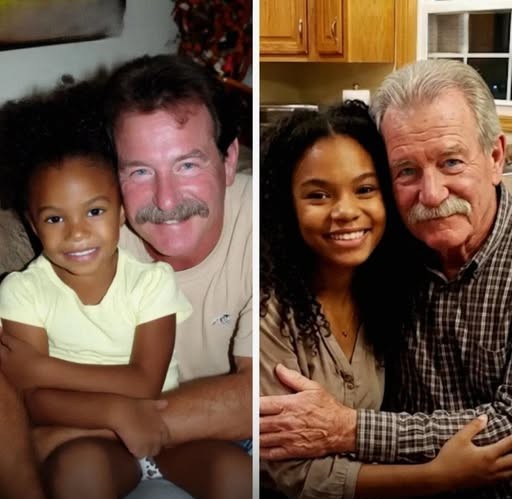
He was completely wrong.
They left around 7 p.m. I remember Michael standing in my doorway with his youngest, Emily, dozing in his arms in her thick coat. He looked calm—the way sons do when they want their fathers to believe everything will be fine.
“We’ll be okay, Dad,” he said. “I just want to get the kids home before it gets too late.”
When I shut the door, the wind roared outside and something twisted deep in my chest. A warning I didn’t understand at the time.
Three hours later, someone knocked.
Not a friendly knock. Not a neighbor stopping by. The kind that makes your stomach drop before you even open the door.
Officer Reynolds stood there, snow melting off his jacket, his face already heavy with bad news.
There had been a crash.
The road Michael took had iced over. The car slid off and hit a line of trees.
Michael was gone.
Rachel was gone.
My grandson Sam—just eight—was gone.
Only Emily survived.
She was five years old.
I remember the hospital hallway. The harsh lights. The hard plastic chairs. My hands wouldn’t stop shaking. Emily had a concussion, broken ribs, deep bruising from the seatbelt. She barely spoke.
The doctors said trauma had blurred her memory. Fragments might come back—or they might not.
So I didn’t push.
Overnight, I became her guardian. I went from grieving father to raising a child again at fifty, with no warning and no time to fall apart. People called her survival a miracle—police, neighbors, even the pastor at the funeral standing in front of three closed caskets trying to make sense of something that doesn’t make sense.
After that, life became a series of small, difficult adjustments.
I learned to cook again. Learned how to comb a little girl’s hair without hurting her. Sat through school events and watched her perform while swallowing my grief like medicine that never tasted right.
Emily didn’t ask for much. She rarely complained. But sometimes she looked at the door like she expected someone else to walk through it.
We didn’t talk much about the accident.
When she asked why her parents weren’t coming back, I gave her the only answer I had:
“It was an accident, sweetheart. A bad storm. Nobody’s fault.”
She accepted it and didn’t ask again.
Years went by. Emily grew into a quiet, thoughtful young woman who loved puzzles and mysteries, like she believed the world made sense if you looked closely enough. She was smart, serious, and more careful with her heart than a child should have to be.
When she left for college, I cried harder than I ever expected. The house felt empty in a way I hadn’t noticed before.
Four years later, she came back home to save money and started working as a paralegal. She had plans, structure, a future mapped out in careful steps.
We fell into a rhythm again—dinner at six, quiet conversations about her work. I didn’t realize how much I needed that until I had it back.
Then, a few weeks ago, just before the anniversary of the crash, something changed.
She became quieter—but not distant. Focused. Like her mind was working through something heavy.
Then the questions started.
“Grandpa, what time did they leave that night?”
“Was anyone else supposed to be on that road?”
“Did the police follow up with you more than once?”
At first I thought she just wanted closure. But the way she watched me when I answered made me uneasy.
Last Sunday, she came home early, still wearing her coat, holding a folded paper in her hand like it might burn her.
“Grandpa,” she said softly, “can we sit down?”
We sat at the kitchen table.
She slid the paper toward me.
“I need you to read this before I explain,” she said. “I have something to tell you.”
I opened it.
In her neat handwriting, it read:
IT WASN’T AN ACCIDENT.
My chest tightened instantly. I tried to laugh it off.
“Emily… what is this?”
She didn’t smile.
“I remember things,” she said quietly. “Things everyone said I wouldn’t.”
Then she took out an old flip phone.
“I found this in the county archive,” she said. “It wasn’t logged as evidence. I had to request it by serial number.”
She explained there were voicemails from the night of the crash—one partially deleted.
I asked what was on it.
“They weren’t alone on that road,” she said. “Someone made sure they didn’t make it home.”
Then she said the name that made my stomach drop.
Officer Reynolds.
She had been digging through records for months. Internal investigations. Old reports. She found that Reynolds had been under investigation for falsifying reports and taking bribes from a trucking company. They paid him to hide accidents and shift blame.
That road should have been closed that night.
A semi had jackknifed earlier.
The barricades had been removed.
Michael drove onto a road that never should have been open.
They swerved to avoid the truck—and crashed.
Emily survived because she was asleep, her seatbelt catching differently.
Reynolds had died years ago. No trial. No charges.
But his wife had found a letter and sent it to us.
In it, she admitted he had taken money, ignored the danger, and never expected anyone to die. He tried to fix it too late.
That night, Emily and I lit candles like we always do at Christmas.
But this time, we talked.
We remembered them together. We cried. We finally understood.
For twenty years, I carried a weight without shape.
Now I know what it was.
And for the first time in a long time, the snow falling outside didn’t feel threatening.
It felt quiet.
Peaceful.
Emily reached across the table and held my hand—not because she needed comfort, but because she was offering it.
“You were right all along,” she said.
And for the first time, I believed it.