I ran outside.
And there he was.
Jeremy.
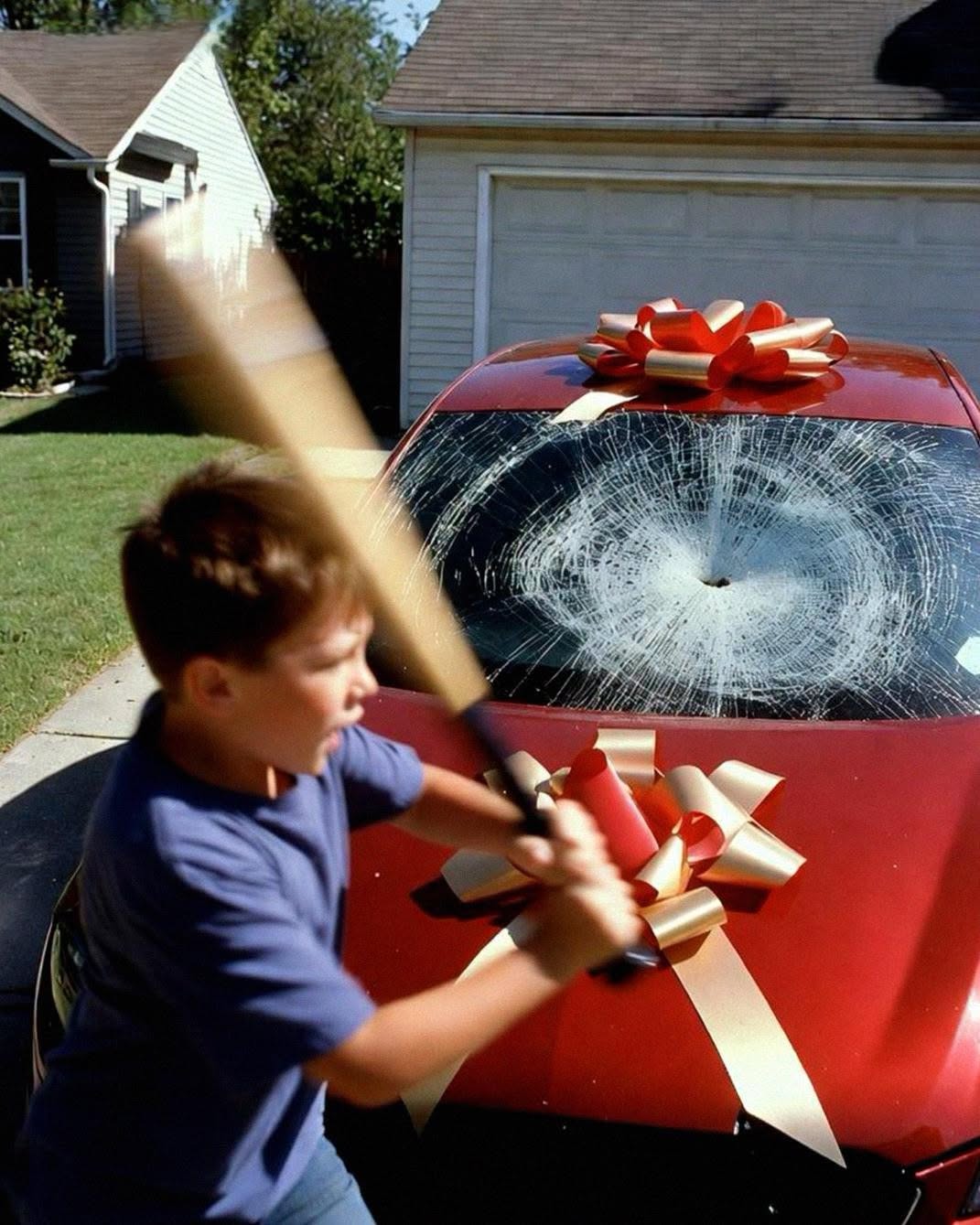
My brand-new car—the one I had spent years saving for—was sitting there with deep marks across the side.
The baseball bat was still in his hands.
For a few seconds, nobody moved.
I just stared.
Not because I couldn’t believe the car was damaged.
Because I couldn’t believe the smile on my sister Kelsey’s face.
“Jeremy,” I said quietly. “What are you doing?”
He lowered the bat slightly.
“I was just playing.”
Playing?
With a baseball bat?
Against a car?
I looked at Kelsey, expecting her to immediately step in.
To apologize.
To discipline him.
Instead, she shrugged.
“He’s a kid,” she said. “It’s not like he meant anything by it.”
That sentence hurt more than the damage itself.
Because she knew.
She knew how much that car meant to me.
She knew I had worked overtime, skipped vacations, and saved carefully just to buy something I had dreamed about for years.
And yet somehow, she treated it like it was nothing.
I took a deep breath.
“Did you tell him he could do this?”
Her expression changed for just a second.
Only for a second.
But I noticed.
“No,” she replied quickly. “Don’t make this into something bigger than it is.”
That was the moment I realized something.
This wasn’t really about the car.
It was about years of excuses.
Every birthday party where Jeremy ruined the day.
Every family gathering where everyone walked on eggshells.
Every time someone said, “He’s just young,” while expecting everyone else to tolerate the consequences.
My mother stepped outside and immediately saw the damage.
“What happened?”
Nobody answered.
Jeremy looked at the ground.
Kelsey crossed her arms.
And I finally spoke.
“Your grandson destroyed my car.”
The driveway went silent.
My mother looked at Kelsey.
“Kelsey?”
For the first time, my sister didn’t have an immediate response.
The next few days were uncomfortable.
Some family members told me I was overreacting.
Others said I should “just let it go.”
But nobody offered to fix the damage.
Nobody offered to take responsibility.
So I made a decision.
I wasn’t going to scream.
I wasn’t going to fight.
I was going to let consequences do what excuses never did.
I contacted my insurance company, got an estimate for repairs, and documented everything.
Then I sat down with Kelsey.
“I’m not angry because of the car,” I told her.
She looked surprised.
“Then why?”
“Because you taught Jeremy that other people’s belongings don’t matter. You taught him that someone else will always clean up his mistakes.”
She looked away.
For once, she had nothing to say.
“I thought you were trying to punish me,” she finally admitted.
“No,” I replied. “I’m trying to stop you from teaching him that actions don’t have consequences.”
A week later, something unexpected happened.
Jeremy came to my house.
Alone.
He stood on the porch holding an envelope.
“I’m sorry,” he said.
I looked at him.
Inside the envelope was money.
Not much.
Just what he had saved from birthdays and small jobs around the house.
“I know it doesn’t fix it,” he said. “But I wanted to help.”
That moment changed something.
Because for the first time, I wasn’t looking at a spoiled child.
I was looking at a kid who was finally beginning to understand responsibility.
I told him the truth.
“I appreciate this. But what matters most is that you understand why it was wrong.”
He nodded.
Months later, the car was repaired.
But the bigger repair happened inside our family.
Kelsey eventually admitted that she had been making excuses for years.
She apologized—not just for the car, but for allowing Jeremy to believe rules didn’t apply to him.
The experience didn’t magically fix everything overnight.
But it started a conversation we had avoided for years.
And sometimes, the hardest lessons aren’t about replacing what was broken.
They’re about teaching people how not to break it again.