“Go change your clothes,” I said quietly.
He didn’t move.
“Mom, I’m sorry.”
I nodded, but I couldn’t look at him.
“Just go get dry.”
He walked upstairs slowly, leaving wet footprints behind him.
I stood in the entryway staring at the empty place where the blue umbrella used to lean against the wall.
And for the first time in months, losing Darren felt fresh again.
Not big and dramatic.
Just sharp.
Like a hand closing around my ribs.
The Umbrella Was Never Just an Umbrella
Darren had bought that umbrella on a ridiculous Tuesday morning twelve years earlier.
I remembered because he had come home laughing.
“It was either this,” he said, holding up the bright blue umbrella, “or one with yellow ducks on it.”
“I would’ve preferred the ducks,” I told him.
“Exactly why I chose this one.”
That was Darren.
He had a way of making ordinary things feel like small celebrations. A new umbrella. A burned pancake. A flat tire. A wrong turn. Somehow, he turned everything into a story.
When Eli was little, he used to beg Darren to carry him under the umbrella even when it wasn’t raining.
They would walk around the backyard while Darren made thunder sounds and Eli squealed.
Sometimes I watched them from the kitchen window and thought, this is what happiness looks like when it doesn’t know it’s being watched.
After Darren died, Eli started carrying that umbrella everywhere.
Even on cloudy days.
Even when the forecast said no rain.
At first, I thought it was strange.
Then I realized he wasn’t carrying it because of the weather.
He was carrying it because it made him feel like his father was still walking beside him.
So I let him.
And maybe, if I’m being honest, I needed him to carry it too.
Because every time I saw it tucked under his arm, I felt like Darren had not completely disappeared from our home.
Then Eli gave it to a stranger.
And I was ashamed of how angry that made me.
The Woman at the Bus Stop
Eli told me the full story later that night.
We were sitting at the kitchen table. His hair was dry now, and he had changed into sweatpants and one of Darren’s old college hoodies, the sleeves hanging past his hands.
“She was sitting on the bench,” he said. “Everyone else had left already. Mr. Collins asked if she was okay, but she said she was fine.”
Mr. Collins was Eli’s bus driver, a gentle older man with silver hair and a voice like warm tea. He knew every child’s name, every parent’s schedule, and somehow always noticed when someone looked sad.
“She didn’t look fine,” Eli continued. “She was shaking. Her paper bag ripped, and her things got wet.”
“What things?”
“I don’t know. Papers. Maybe mail. Maybe something important.”
I pictured a woman alone in the rain, trying to hold herself together in public.
Eli looked down at his hands.
“I thought Dad would give her the umbrella.”
That was the sentence that broke me.
Not because it hurt less.
Because it hurt more.
He was right.
Darren would have given her the umbrella.
No hesitation.
No calculation.
No dramatic speech.
He would have handed it over, smiled, and walked home soaked.
Because that was exactly the kind of man he had been.
I took a slow breath.
“I know,” I said.
Eli looked up.
“Are you still mad?”
I wanted to say no.
But I had promised myself after Darren died that I would not teach Eli to hide hard feelings just to make other people comfortable.
So I told him the truth.
“I’m not mad that you helped her,” I said. “I’m proud of that.”
His face softened.
“But I’m sad about the umbrella.”
He nodded.
“Me too.”
We sat in silence for a while.
Then he whispered, “I thought maybe Dad wouldn’t mind.”
I reached across the table and took his hand.
“No,” I said. “I don’t think he would.”
But when Eli went to bed, I cried in the laundry room with the dryer running so he wouldn’t hear me.
The Facebook Post
Two days passed.
The rain stopped.
The empty umbrella stand by the door stayed empty.
I tried not to look at it.
Then on Sunday evening, my sister Mara called.
“Have you been on Facebook?” she asked.
“No.”
“You need to look.”
I already hated the way she said it.
“What happened?”
“Just look up Jenelle Carter. Or search Eli’s name.”
My stomach dropped.
“Why?”
“Please don’t panic. It’s not bad.”
That, of course, made me panic.
I opened Facebook and typed in Eli’s name.
The post appeared immediately.
There was no photo of Eli, thank God. Just a picture of the blue umbrella leaning against a kitchen chair.
The caption was long, messy, and clearly written by someone who had cried while typing.
Jenelle Carter explained that she had been stranded at a bus stop in the rain after one of the worst mornings of her life. She had missed one bus, dropped her paperwork, and felt completely invisible.
Then a little boy had stepped off his school bus, noticed her, and handed her his umbrella.
Not just any umbrella, she wrote.
A blue umbrella he said had belonged to his dad.
She said she tried to refuse it, but he insisted.
“He told me, ‘My dad used to say umbrellas are for people who need them most.’”
I covered my mouth.
Darren had said that.
Once.
Maybe twice.
I didn’t even know Eli remembered.
Jenelle continued, saying she had not stopped thinking about the boy who walked away in the rain so a stranger could stay dry. She didn’t know how to find us, so she posted the story hoping someone could help her return the umbrella and thank him properly.
The post had been shared thousands of times.
Thousands.
Comments poured underneath it.
People called Eli an angel.
A hero.
A sign of hope.
A reminder that kindness still existed.
Some people asked where to send him gifts.
Others wanted our address.
That was where my stomach twisted again.
I didn’t want strangers praising my child like he was public property.
I didn’t want our grief turned into a feel-good story for people to consume between recipes and arguments.
I didn’t want Darren’s umbrella becoming entertainment.
I clicked away from the post and sat frozen on the couch.
Then the doorbell rang.
The First Umbrella
A woman stood on our porch holding the blue umbrella.
She looked nervous, tired, and deeply uncomfortable.
“I’m Jenelle,” she said.
I opened the door slowly.
For a second, neither of us spoke.
Then she held out the umbrella with both hands, like it was something fragile.
“I’m so sorry,” she said. “I didn’t know what it meant when he gave it to me. Not really. I tried to get him to take it back, but he was already walking away.”
I looked at the umbrella.
The faded blue fabric.
The scratched handle.
The crooked rib.
It was Darren’s.
It was back.
And somehow that made me want to cry harder than when it had been gone.
Eli came running when he heard voices.
He stopped when he saw Jenelle.
“Oh,” he said softly. “Hi.”
Jenelle knelt so she was closer to his height.
“Hi, Eli.”
He looked embarrassed.
“You didn’t have to bring it back.”
“I did,” she said. “And I wanted to say thank you properly.”
Eli shrugged, uncomfortable with the attention.
“It was just raining.”
Jenelle smiled through tears.
“It was more than that to me.”
She told us she had been on her way home from a difficult appointment. She didn’t give many details, and I didn’t ask. Some pain does not need to be opened in front of strangers to be real.
She only said that when Eli gave her the umbrella, it was the first kind thing that had happened to her all day.
Maybe all week.
Maybe longer.
“I know this belonged to your dad,” she said to Eli. “So I brought it home.”
Eli reached for it, then hesitated.
“You used it though, right?”
Jenelle nodded.
“I did.”
“Good,” he said.
That was all.
Just good.
Like the umbrella had completed some mission he had trusted it with.
Then the Boxes Came
By Monday morning, the post had spread even further.
By Tuesday, local people were sharing it in community groups.
By Wednesday, someone had left an umbrella on our porch.
It was red with white polka dots.
There was a note attached.
For the boy who reminded me to be kinder.
I didn’t know what to do with it.
By Thursday, there were five more.
By Friday, there were seventeen.
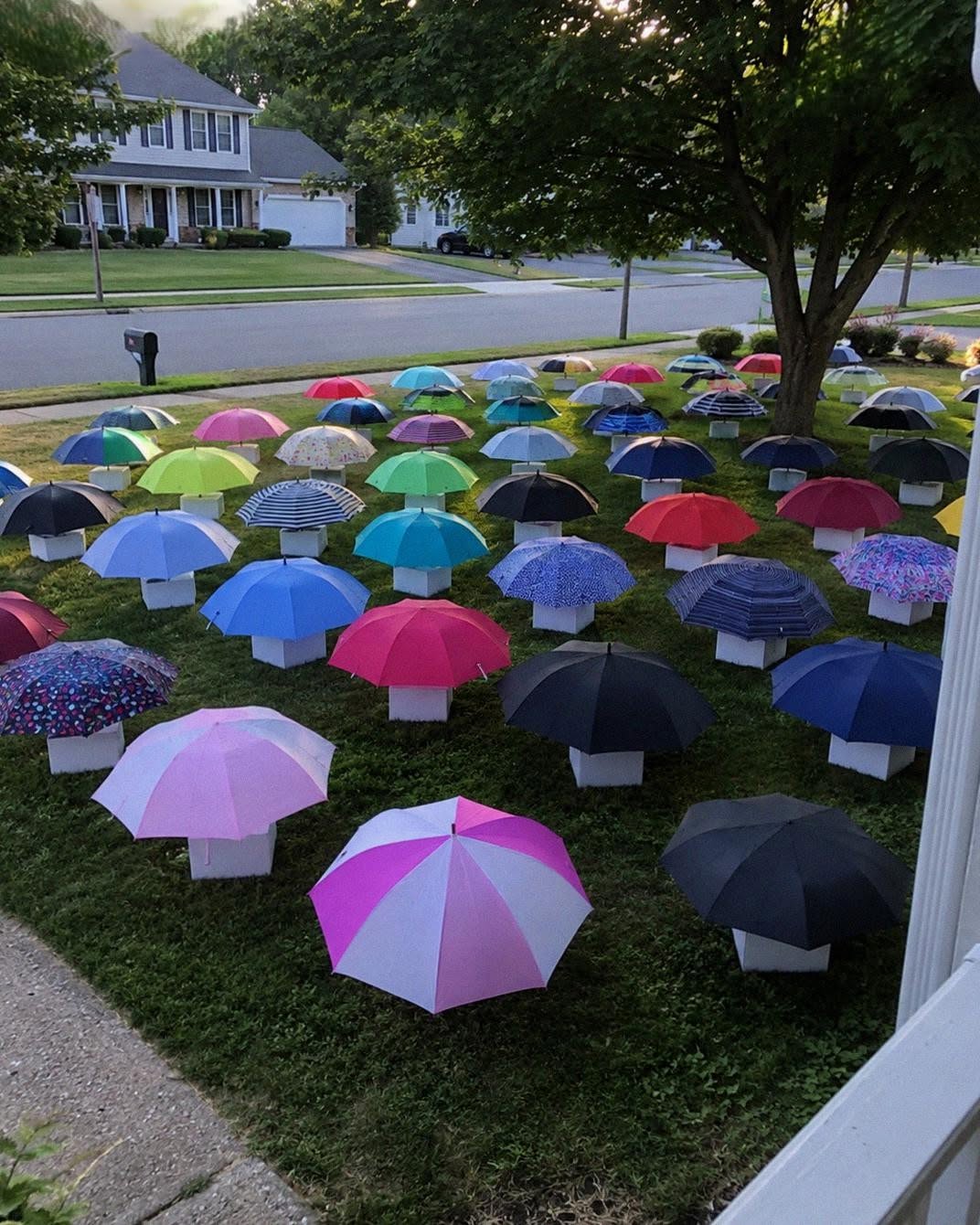
By the end of the next week, there were forty-seven umbrellas and forty-seven small boxes arranged across our front yard, porch steps, and driveway.
Some were new.
Some were used but carefully cleaned.
Some were children’s umbrellas shaped like frogs and dinosaurs.
Some were plain black business umbrellas.
One had sunflowers printed all over it.
One had tiny stars.
One was bright yellow and came with a note that said:
I was your son once. Someone was kind to my mother when she needed it. I never forgot.
The boxes held gift cards, bus passes, gloves, ponchos, handwritten letters, and small toys for Eli.
Some notes were sweet.
Some were heartbreaking.
One woman apologized for not standing up for a classmate when she was young.
One man wrote that Eli’s story made him call his estranged brother.
A retired teacher sent five umbrellas and wrote, Children are watching us. Sometimes they become better than we taught them to be.
I read that one three times.
Still, the whole thing overwhelmed me.
I didn’t want cameras.
I didn’t want interviews.
I didn’t want strangers driving slowly past our house.
And I definitely didn’t want Eli thinking that kindness should always come with applause.
So I made a post of my own.
I thanked everyone.
Then I asked them to stop sending things to our home.
I wrote that Eli was a child, not a symbol.
I wrote that our family was grateful, but we needed privacy.
Most people respected it.
A few didn’t.
That part hurt.
Because even kindness can become too heavy when people forget there is a real family underneath the story.
Setting Boundaries
The next few days were strange.
People meant well, but good intentions do not automatically make everything okay.
A local news page messaged me.
Then another.
Someone asked if Eli could “recreate the moment” at the bus stop.
I deleted that message so fast my hands shook.
No.
Absolutely not.
My son was not going to stand in the rain for a camera so strangers could feel inspired.
Darren’s memory was not a prop.
Our grief was not content.
Jenelle understood immediately.
She sent me a message that said:
I am so sorry this got bigger than I expected. I only wanted to find you. Tell me how to help make it smaller.
That message changed everything.
Because she didn’t defend herself.
She didn’t say, “But people are being nice.”
She understood that attention, even positive attention, can still feel like being surrounded.
So we talked.
Then we met at the bus stop with Mr. Collins.
He arrived in his yellow bus after his afternoon route, parked by the curb, and stepped down with a thermos in one hand.
“I figured this would happen,” he said.
“You did?” I asked.
He nodded toward the pile of umbrellas we had brought in the trunk.
“People like a story with rain and a good kid. Makes them want to prove they would’ve helped too.”
That was exactly it.
People were not only responding to Eli.
They were responding to the version of themselves they wanted to be.
The question was what to do with all of it.
Route 47 Rain Rack
The idea came from Eli.
He had been quiet while the adults talked.
Then he pointed to the bus stop sign.
“What if the umbrellas stayed here?”
I looked at him.
“Here?”
“Yeah,” he said. “For people who need them.”
Mr. Collins smiled.
“Like a little free library, but for rain.”
Jenelle nodded slowly.
“Umbrellas. Ponchos. Gloves maybe.”
“And bus passes,” I added, thinking of the gift cards and transit cards people had sent.
Eli’s face brightened.
“Can we make it blue?”
Of course he wanted it blue.
So that weekend, with help from Jenelle, Mr. Collins, and two neighbors who were very good with tools, we built a small wooden stand near the bus stop.
We painted it blue.
Not exactly the same shade as Darren’s umbrella, but close enough to make my throat tighten.
Across the top, Mr. Collins carefully painted the words:
Route 47 Rain Rack
Underneath, in smaller letters, Eli wrote:
Take what you need. Leave what you can. Stay dry.
We stocked it with umbrellas, ponchos, gloves, hand warmers, and bus passes sealed in small waterproof sleeves.
We did not put Eli’s full name on it.
We did not put Darren’s name on it.
We kept the story simple.
Because the point was not to make a monument out of my son.
The point was to make sure the next person caught in a storm did not have to stand there alone.
The Old Umbrella Came Home
Darren’s original blue umbrella did not go on the rack.
That was Eli’s decision.
At first, I thought he might want to share it again. Part of me even wondered if that would be the “right” ending.
But grief does not need to perform generosity for anyone.
Some things can be shared.
Some things can be kept.
Both can be love.
Eli held the old umbrella under his arm while we stocked the rack with the new ones.
A fresh blue umbrella hung on the side hook, ready for someone who might need it.
The old one stayed with him.
“For remembering,” he said.
I nodded.
“And the new one?”
“For sharing.”
That made sense.
More sense than anything I could have come up with.
What Darren Really Left Behind
For months after Darren died, I kept looking for him in objects.
His jacket.
His coffee mug.
His watch.
His umbrella.
I clung to those things because they gave my grief something solid to hold.
But watching Eli at that bus stop, I understood something I had been too heartbroken to see.
Darren was not only in the things he left behind.
He was in the way Eli noticed people.
He was in the way my son saw a stranger shaking in the rain and decided her comfort mattered too.
He was in the way Eli gave without making a speech.
Without expecting praise.
Without even telling me until I asked.
That was Darren.
Not the umbrella.
The instinct.
The quiet kindness.
The willingness to get wet so someone else could stay dry.
I had been afraid that giving away the umbrella meant Darren was disappearing again.
But maybe the opposite was true.
Maybe, for one rainy afternoon, Darren had been more present than ever.
Not in the fabric.
Not in the handle.
Not in the bent metal rib.
In Eli.
The First Person Who Used the Rack
The Rain Rack stood untouched for two days.
Then, on Wednesday morning, I drove past after dropping Eli at school and saw an older man standing beside it.
He read the sign.
Looked up at the clouds.
Then took a black umbrella from the rack.
He opened it carefully and walked toward the bus bench.
That was all.
No music swelled.
No crowd clapped.
No one posted about it.
It was quiet.
Ordinary.
Perfect.
That afternoon, someone had returned the umbrella and left a pair of gloves.
The next day, two ponchos were gone.
By the end of the week, someone had added a packet of tissues, a folded rain hat, and a note in shaky handwriting:
Needed this today. Thank you.
Eli kept that note in his desk drawer.
Not because it praised him.
It didn’t.
It praised the rack.
The idea.
The small circle of people helping each other without needing to know each other’s names.
Jenelle Stayed
Jenelle became part of our lives in a quiet way.
Not dramatically.
Not like some movie where strangers become family overnight.
Real life is slower than that.
She came by sometimes to help restock the rack.
She and Eli developed a habit of checking the weather together.
If the forecast showed rain, she would text:
Route 47 might be busy tomorrow.
Eli would pack extra ponchos in the car.
Mr. Collins kept an eye on the stand during his route. If something ran low, he told us. Sometimes he added items himself. Once he left a thermos of hot chocolate beside the rack with paper cups and a note that said:
For cold hands only.
That lasted about twenty minutes.
But it made people smile.
And that mattered too.
The Line Between Remembering and Letting Go
I still missed Darren every day.
That did not change.
People sometimes talk about healing like it means hurting less until the pain disappears.
That is not how it worked for me.
Healing felt more like learning where to put the pain.
Some of it belonged in quiet mornings.
Some of it belonged in old photographs.
Some of it belonged in stories I told Eli before bed.
And some of it, I realized, belonged out in the world.
In small acts.
In shelter offered.
In kindness passed from one person to another.
The blue umbrella had once protected Darren.
Then it protected Eli.
Then it protected Jenelle.
Then it helped create something that protected strangers.
Maybe that was not losing it.
Maybe that was letting it do what it had always been meant to do.
The Rain Came Again
A month after the Rain Rack went up, a heavy storm rolled through town.
The sky went dark in the middle of the afternoon, and rain hit the windows so hard it sounded like handfuls of gravel.
Eli stood by the front door holding Darren’s umbrella.
“Can we check the rack?” he asked.
We drove slowly through the storm.
When we reached the bus stop, three umbrellas were missing. Two ponchos were gone. One bus pass sleeve was empty.
And hanging from the side of the rack was something new.
A small blue ribbon.
No note.
No name.
Just a ribbon tied carefully around the wood.
Eli stared at it through the car window.
“Someone said thank you,” he said.
“I think so.”
He smiled.
Then he looked down at the old umbrella in his lap.
“Dad would like this.”
I could barely answer.
“Yes,” I said. “He really would.”
The Gift I Almost Missed
For a while, I thought Darren’s last gift to Eli was the umbrella.
I was wrong.
The umbrella was only the shape the gift took for a little while.
Darren’s real gift was the example he left behind.
The way he moved through the world.
The way he treated strangers like they mattered.
The way he made generosity feel normal instead of heroic.
And somehow, even after losing him, Eli had learned it.
Not because I gave a speech about kindness.
Not because anyone told him to be brave.
But because he remembered how his father lived.
That is what children carry forward.
Not only what we buy them.
Not only what we leave in closets or drawers or umbrella stands.
They carry the way we treat people when we think nobody is watching.
They carry the small choices.
They carry the tone of our voices.
They carry the moments we don’t even realize are teaching them.
Eli gave away the blue umbrella because Darren had already given him something bigger.
A heart that noticed the rain falling on someone else.
And a willingness to step into it.
What Stayed, What Changed
The old blue umbrella still comes home every day.
It leans by the door when Eli finishes school.
Sometimes he takes it to his room.
Sometimes he opens it in the backyard when there is no rain at all.
I no longer tell him not to.
A new blue umbrella hangs on the Route 47 Rain Rack.
That one is for sharing.
The old one is for remembering.
And both matter.
Because love is not only what we keep safe.
Sometimes love is what we send back out into the world.
Sometimes it returns.
Sometimes it becomes forty-seven umbrellas.
Sometimes it becomes a blue stand by a bus stop.
Sometimes it becomes a stranger staying dry on the hardest day of her week.
And sometimes it becomes a little boy standing in the rain, holding nothing, but carrying everything his father taught him.
I used to think losing the umbrella meant losing another piece of Darren.
Now I know better.
Darren wasn’t gone from that moment.
He was everywhere in it.
In Eli’s choice.
In Jenelle’s gratitude.
In Mr. Collins’s steady kindness.
In every person who left something for someone else.
And in the quiet blue rack waiting at Route 47 for the next storm.
Would you have let Eli keep the old umbrella, or placed it on the rack too? Share your thoughts below — and send this story to someone who believes small acts of kindness can travel farther than we ever expect.