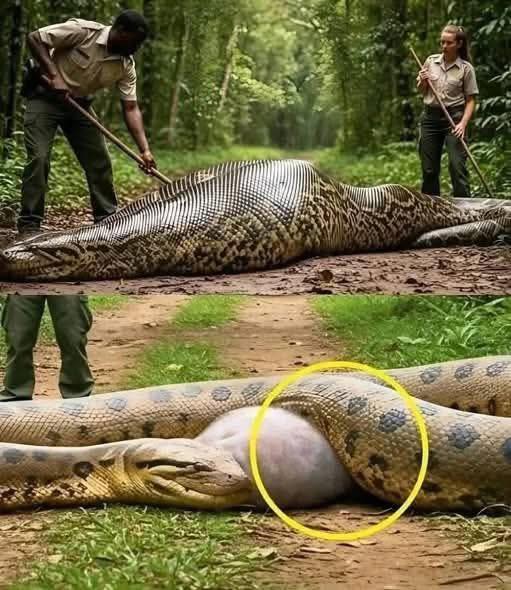
Unfortunately, that mistake can be deadly.
A High-Risk Rescue
Realizing the urgency, the rangers prepared for a delicate and dangerous intervention. Handling an anaconda—especially one of this size—is no small task. Even weakened, it can still pose serious risks.
Using specialized tools and careful coordination, the team began a slow process to help the snake expel the object. Every move had to be precise. Too much pressure could cause internal injury, while hesitation could cost the animal its life.
After hours of careful effort, the object was finally removed.
It turned out to be a large, rusted container—likely discarded waste that had made its way into the wetland. Its sharp edges could have caused severe internal damage if left inside.
A Fragile Recovery
Once the obstruction was cleared, the focus shifted to recovery. The anaconda remained still at first, conserving energy after the ordeal.
Gradually, signs of life returned.
Its breathing steadied. Its tongue flicked more frequently, sensing its surroundings again. Slowly, it regained enough strength to move—sliding back into the water where it belongs.
For the rangers, it was a moment of relief.
Why This Matters
Top predators like the green anaconda play a critical role in maintaining ecological balance. Their presence helps regulate populations of other species, keeping the ecosystem stable.
But this incident highlights a growing problem—human waste reaching even the most remote environments.
Plastic, metal, and other debris don’t just disappear. They travel through waterways, becoming hidden dangers for wildlife that has no way to distinguish them from food.
A Bigger Picture
While this rescue had a positive outcome, it raises an important question: how many animals aren’t found in time?
Conservation efforts like this depend on awareness, responsibility, and action. Protecting natural habitats isn’t just about preserving beauty—it’s about preventing harm before it happens.
Stories like this remind us that small actions can have lasting consequences.
What are your thoughts on protecting wildlife from pollution? Share your opinion below and join the conversation.