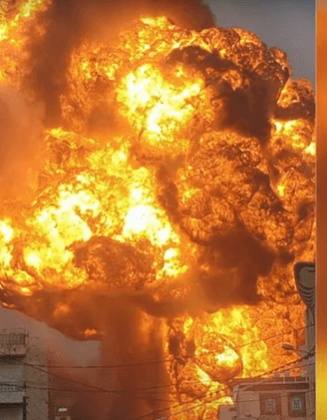
Reports circulated suggesting potential casualties among senior Iranian officials, though Iranian media confirmed that key leaders were unharmed. Analysts note that this operation represents a shift from limited regional skirmishes to broader, high-stakes confrontation.
Iran Responds Quickly
Within hours, Iran’s Islamic Revolutionary Guard Corps (IRGC) launched missiles and drones targeting Israel and U.S. military bases across the region, including sites in Qatar, the UAE, Bahrain, Kuwait, Jordan, Iraq, and Saudi Arabia. These actions have raised concerns about a wider regional conflict.
Iran’s naval forces also issued warnings to commercial vessels in the Persian Gulf, advising that the Strait of Hormuz was unsafe for passage. While Iran has not formally declared a full blockade, shipping in the strait has been disrupted, with many tankers rerouting or pausing transit. Authorities from the EU and the UK confirmed that commercial vessels were receiving these warnings, and U.S. naval forces issued advisories to exercise caution.
The Importance of the Strait of Hormuz
The Strait of Hormuz is a critical maritime route connecting the Persian Gulf to the Gulf of Oman and the Arabian Sea. Roughly 20% of global oil flows through this narrow channel, including major exports from Saudi Arabia, Iraq, Kuwait, the UAE, and Qatar. Even short-term disruptions could significantly increase shipping costs and force longer, more expensive alternative routes.
Iran has previously threatened to close the strait during past crises, but a full, sustained shutdown has never occurred. Analysts highlight Iran’s asymmetric capabilities—fast attack boats, missiles, and naval mines—that could pose serious risks to shipping, even without traditional naval dominance. Meanwhile, U.S. forces are reportedly on high alert to ensure safe passage and respond if needed.
Global Market Implications
Oil markets are closely monitoring the situation. Analysts predict significant price volatility once trading resumes, with potential spikes ranging from $5 to $20 per barrel initially. Prolonged disruptions could push Brent crude above $100 per barrel. Higher energy costs would impact global gasoline prices, transportation, manufacturing, and supply chains, with potential economic consequences in the U.S., Europe, and Asia.
Economists warn that even partial disruptions in the strait could trigger inflationary pressures and affect global economic growth. Shipping insurance rates are rising, reflecting the increased risk in the region.
Broader Geopolitical Concerns
This escalation follows a series of tensions involving oil-producing nations in 2026 and raises the stakes in an already volatile region. Iran’s regional proxies, including groups in Yemen and Lebanon, could be drawn into further conflict, while Gulf states hosting U.S. forces face increased exposure. Diplomacy appears stalled, and the risk of further escalation remains high.
While the situation continues to develop, analysts emphasize that most current disruptions are asymmetric harassment rather than full-scale naval confrontation. The world is watching closely to see if tensions remain limited or escalate into broader conflict.