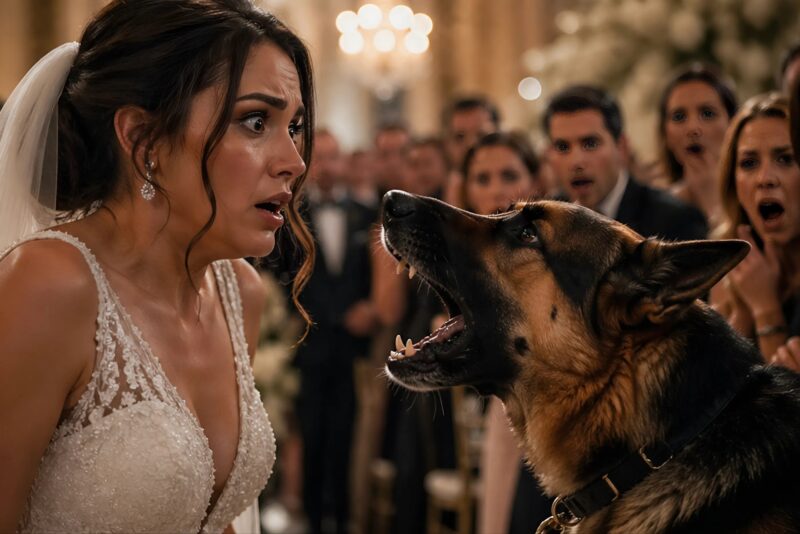
Something small but heavy dropped from beneath the layers of her gown and hit the polished floor.
The room fell silent.
The groom stared down at the object.
It was a phone.
Not just any phone—a second phone, carefully hidden in a pocket sewn into the inside of the wedding dress.
The bride’s face went pale.
No one moved.
The German Shepherd stepped back, still alert, his eyes fixed on the object as if he had known it was there all along.
The groom bent down slowly and picked up the phone. Before anyone could say a word, the screen lit up with a new message.
A preview appeared across the display.
“Once the ceremony is over, transfer the funds immediately.”
A stunned murmur swept through the guests.
The bride rushed forward. “Give that to me.”
But the groom held it out of reach.
Another message appeared.
“Make sure he signs before the reception. Don’t leave without the account access.”
The groom looked up, confusion giving way to disbelief.
“What is this?”
The bride opened her mouth, then closed it again.
“It’s not what it looks like,” she said finally, though her voice lacked conviction.
The guests exchanged uneasy glances. The officiant quietly stepped aside.
The groom unlocked the phone using facial recognition—the bride had inadvertently glanced at it while trying to grab it.
What he found turned the wedding into something no one would ever forget.
There were dozens of messages between the bride and a man whose contact name simply read: D.
The conversations stretched back months.
At first, they seemed ordinary. But as he scrolled, a pattern emerged.
They weren’t discussing a marriage.
They were discussing a plan.
Specific details about the groom’s finances. Questions about his investments. Notes about prenup clauses. Timelines for accessing joint accounts after the ceremony.
One message read:
“After six months, it will be easier. Just stay patient.”
Another said:
“He trusts you completely. That’s the key.”
The groom’s hands trembled.
“Who is D?” he asked.
The bride looked toward the back of the room.
That was when a man near the last row stood up abruptly and tried to leave.
Several guests turned at once.
The groom’s best man moved quickly, blocking the aisle.
The man stopped, clearly realizing there was no easy exit.
“I can explain,” the bride said, tears filling her eyes.
But the explanation came too late.
The groom looked at the dog—his loyal companion, who had never once behaved unpredictably.
Then he looked back at the woman he had been moments away from marrying.
The contrast was impossible to ignore.
The dog had sensed what no one else had.
Not through magic, but through instinct.
Perhaps it was the unfamiliar scent of the hidden phone. Perhaps it was the bride’s nervousness. Or perhaps dogs simply notice what humans often miss.
Whatever the reason, that single moment changed everything.
The ceremony was quietly called off.
Guests slowly filed out, still whispering about what they had witnessed.
The bride left shortly afterward, accompanied by a family member. The unidentified man was also asked to leave.
As for the groom, he sat alone for a while on the front steps of the venue, his German Shepherd resting faithfully beside him.
One of his friends eventually joined him and asked if he was all right.
He looked down at the dog, gently scratching behind his ears.
“I will be,” he said. “Thanks to him.”
Months later, the story had become something of a local legend.
Not because of the canceled wedding.
But because of the dog who refused to ignore what felt wrong.
And in the end, the groom often said he didn’t lose a bride that day.
He gained clarity.
And a renewed appreciation for the friend who had protected him when it mattered most.