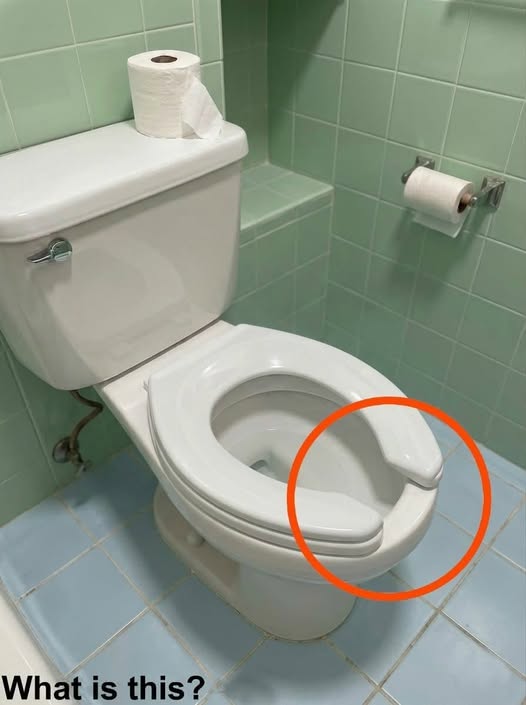
“Why does your toilet seat have that opening in the front?”
She laughed immediately.
Not in a mean way.
More like she was surprised I had never noticed one before.
“That’s how some toilet seats are made,” she said.
That answer only made me more curious.
Because to me, it didn’t look like a design choice.
It looked like something was missing.
And that’s what made the whole thing interesting. Sometimes we use ordinary objects every day without ever thinking about why they look the way they do. Then one tiny detail catches our attention, and suddenly the most normal thing feels unfamiliar.
It Wasn’t Broken at All
Later, I looked into it and found the answer.
The toilet seat was not broken.
It was not damaged.
It was not missing a piece.
That open-front shape is intentional.
The design is often used in public restrooms, offices, restaurants, schools, airports, hospitals, and other shared spaces. It is made that way for practical reasons, mainly hygiene and easier use.
The open gap at the front helps reduce contact with the front section of the seat. That can make the experience feel cleaner, especially in bathrooms used by many people throughout the day.
It also makes the seat easier to clean because there is less enclosed surface around the front area.
So what looked strange at first actually had a simple purpose.
It was designed to be cleaner, easier to maintain, and more practical.
Why the Open Front Matters
Bathrooms are places where small design choices matter more than people realize.
A toilet seat may seem basic, but its shape affects how people use it, how easy it is to clean, and how much contact users have with different surfaces.
The open-front design helps solve a few simple problems:
It creates extra space at the front.
It reduces direct contact with the seat.
It makes cleaning slightly easier.
It can be more convenient in shared bathrooms.
That’s why the design is common in many commercial and public places.
Most people just don’t stop to think about it.
You see it, use it, and move on.
Until one day, you notice the gap and wonder why the seat looks incomplete.
A Small Design That Most People Ignore
The funny part is that open-front toilet seats are not rare.
Many people have seen them dozens of times without giving them a second thought.
But because bathrooms are so routine, we don’t usually study the fixtures. We don’t stop and analyze the shape of a toilet seat. We just assume everything is normal.
That’s why the design can feel so surprising when you finally notice it.
It’s not new.
It’s not unusual.
It’s just one of those everyday details hiding in plain sight.
And once you know the reason, the design suddenly makes sense.
Everyday Objects Usually Have a Reason
This little discovery was a reminder that common objects often have more thought behind them than we realize.
A toilet seat, a door handle, a bottle cap, a zipper, a shopping cart, a keyboard key — so many ordinary things have small design choices built into them.
Some choices are about comfort.
Some are about safety.
Some are about cleaning.
Some are about making the item easier to use.
The open-front toilet seat is one of those simple designs that looks odd until you understand the logic behind it.
It is not made to look fancy.
It is made to be practical.
What Looked Like a Flaw Was Actually the Point
At first, the open-front toilet seat looked incomplete.
But the missing section was not a mistake.
It was the feature.
That small gap at the front exists for hygiene, convenience, and easier cleaning. It is especially useful in bathrooms where many different people use the same facilities.
Once I understood that, the mystery disappeared.
The seat no longer looked broken.
It looked intentional.
And that’s the interesting part.
Sometimes the things we think are flaws are actually carefully planned solutions.
The Simple Lesson Behind the Strange Design
What started as an awkward question in a friend’s bathroom turned into a small lesson about everyday design.
The open-front toilet seat may not seem important, but it shows how even the most ordinary objects are shaped by real-life needs.
A small change in design can make something cleaner, easier to maintain, and better suited for shared use.
And sometimes, all it takes is one random moment of curiosity to notice something that has been there all along.
So no, the toilet seat was not broken.
It was doing exactly what it was designed to do.
And now, every time I see one, I’ll probably think about how such a simple detail can make people stop, stare, and ask a question they never expected to ask.
Have you ever noticed a strange design in an everyday object and later found out it had a smart reason behind it? Share your thoughts below — and send this to someone who loves discovering the hidden logic behind ordinary things.