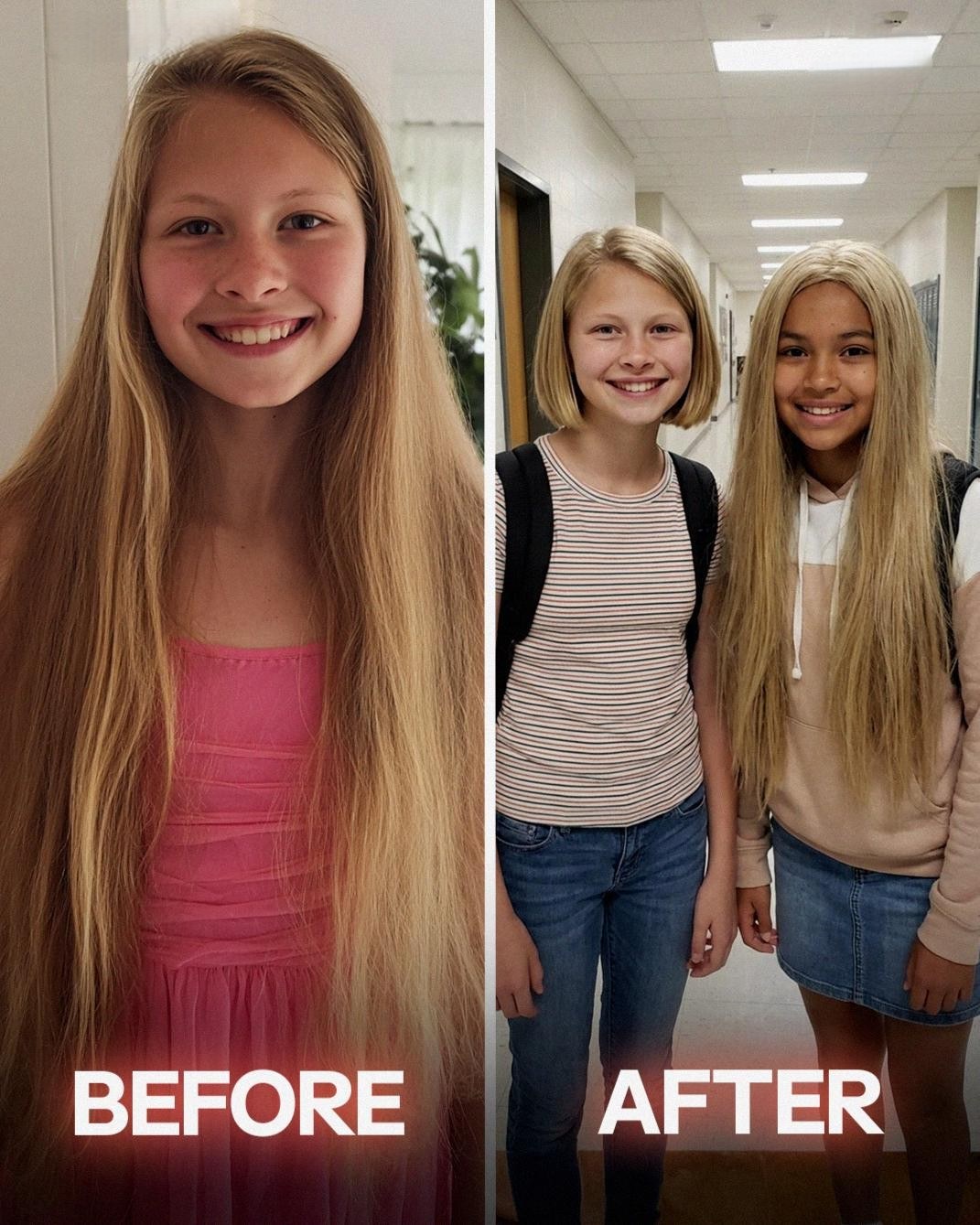
I couldn’t bring myself to be angry. Jonathan had gone through cancer himself in his final months, and Letty had watched every difficult moment with a quiet, aching understanding. That night, instead of punishment, there was only pride—and a visit to Teresa’s salon, where kindness turned into action.
Teresa and her husband Luis, who had worked alongside Jonathan at the plant, understood immediately what Letty had done. By morning, the story had traveled farther than any of us expected.
Back at the school, the full truth was waiting.
Inside the principal’s office stood Millie, wearing a carefully crafted wig made with care and urgency overnight. Her mother stood nearby, overwhelmed with emotion. And in the center of the room were six plant workers—men who had spent years working alongside Jonathan.
On the desk sat an old yellow hard hat.
Jonathan’s.
Luis stepped forward first, his voice steady but emotional. He explained that after hearing what Letty had done, they had all come together. These men weren’t there out of confusion or anger—they had come because of a promise.
A worn envelope was placed in my hands, my name written in Jonathan’s familiar handwriting.
Inside was more than a message.
It was a vision he had quietly built long before any of us knew.
The men explained that Jonathan had started something small at the plant—a fund created during his illness. He called it the “Keep Going Fund.” It was built from small contributions, spare change, and quiet generosity between coworkers who refused to let struggling families face hardship alone.
What they placed on that desk that day wasn’t just money.
It was stability. Relief. A future for a family in need.
And then came the note.
Jonathan’s handwriting, steady and unmistakable, spoke directly to them:
“If my girls ever forget what kind of man I tried to be, remind them by how you show up. Let Letty lead with her heart. And don’t let either of them stand alone.”
The room fell completely silent.
Even the air felt heavier.
The principal, visibly moved, shared that the school had already taken action regarding the bullying. More importantly, they planned to build programs centered on empathy and inclusion—so no child would ever feel isolated the way Millie had.
Jonathan, even in his absence, was still shaping outcomes.
Outside the office, I finally opened my own envelope.
His words weren’t loud or dramatic. They were steady—like him. He reminded me not to close myself off from people who cared, not to let grief build walls where love should be. He knew me too well. He knew my instinct would be to endure alone.
But I wasn’t alone.
Not anymore.
On the drive home, Letty sat quietly in the passenger seat, holding her father’s worn yellow hard hat in her lap. After a while, she asked softly if I thought her dad would have cried if he had seen everything that day.
I smiled through tears.
“Yes,” I told her. “And then he would’ve pretended he didn’t.”
When we pulled into the driveway, something felt different. The house was still the same. The keys still hung by the door. But they didn’t feel like absence anymore.
They felt like continuity.
Like a promise being carried forward.
Jonathan wasn’t there in body, but he was there in everything else—in the courage of our daughter, in the loyalty of his coworkers, and in the way love continued to move through people he had once known.
And for the first time since losing him, the silence in our home didn’t feel empty.
It felt held.
If this story touched you, share it with someone who needs a reminder that love doesn’t end—it changes form and keeps living through the people we leave behind.