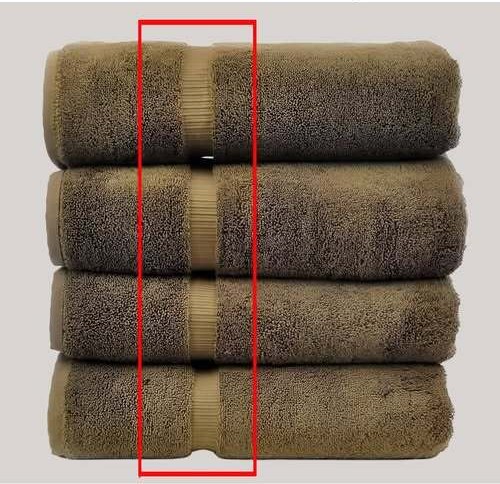
The main body of a towel is made with terry cloth loops. Those loops are great for absorbing moisture because they create more surface area. But the edges of a towel need extra support, especially after repeated washing, drying, pulling, folding, and daily use.
That is where the dobby border helps.
It Helps the Towel Hold Its Shape
Towels go through a lot.
They get wet.
They get stretched.
They get twisted.
They go through hot wash cycles.
They tumble around in dryers again and again.
Without reinforcement, the edges can start to curl, stretch, shrink unevenly, or fray. The dobby border helps stabilize the towel so it keeps a cleaner rectangular shape over time.
This is one reason higher-quality towels often fold better and look neater in a bathroom or linen closet.
It Reduces Fraying and Warping
The ends of a towel are usually the first areas to show wear.
A tightly woven border gives the towel extra strength where it needs it most. It helps prevent the fabric from unraveling too quickly and keeps the edges from becoming loose or distorted.
That small detail can make a big difference in how long a towel stays usable.
It Makes Towels Easier to Fold and Store
Have you ever noticed that cheaper towels sometimes look messy after a few washes? The ends may pucker, flare out, or fold unevenly.
A good dobby border helps reduce that problem.
Because the band adds structure, the towel lies flatter and stacks more neatly. That is part of the reason hotel towels often look crisp and organized even after repeated laundering.
It Adds Style Without Hurting Absorbency
The dobby border also gives towel makers a place to add design.
Patterns, textures, logos, and decorative details can be woven into the border without interfering with the absorbent terry cloth in the center of the towel.
That means the towel can still do its main job — drying your skin — while also looking more polished.
It is one of those rare design details that is both useful and attractive.
Why the Internet Got Curious About It
The raised towel stripe recently became a funny topic online because people started guessing what it was for.
Some thought it was just decoration.
Some thought it marked different towel sections.
Some joked that it had a secret hygiene purpose.
But the truth is simpler: it is a built-in support system for the towel.
That tiny band is there because towels are not just soft fabric. They are everyday household items designed to survive moisture, friction, heat, and constant washing.
A Small Detail With a Big Purpose
The dobby border is easy to overlook, but it plays an important role.
It helps your towel:
Stay in shape
Fold neatly
Resist fraying
Last longer
Look more finished
Handle repeated washing better
So the next time you grab a towel after a shower, that raised stripe may not seem so random anymore.
Final Thoughts
The line near the edge of your towel is not a mistake, a mystery code, or just a decorative stripe. It is a smart design feature that helps keep the towel strong, stable, and useful over time.
Sometimes the most ordinary household items have clever details hiding in plain sight.
Did you know what the towel stripe was for, or did you have your own theory? Share your guess in the comments and see how many people noticed it too.