

She Was Told to Stay Out of the Wedding Photos—Her Grandfather Made Sure Everyone Heard Her Story
There is a kind of grief that arrives without warning.
Not the grief of a funeral or a hospital room, when everyone understands that something terrible has happened. This grief comes later.
It arrives in ordinary moments.
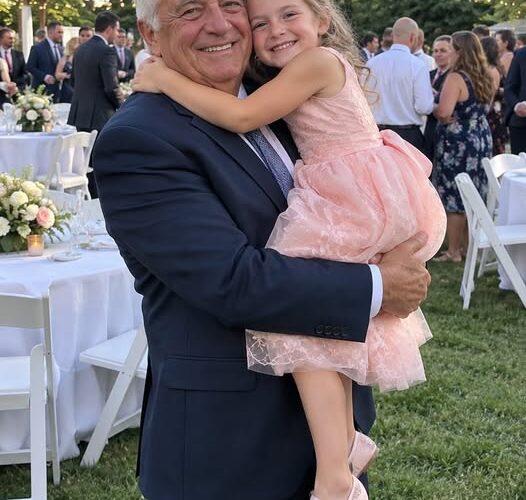
For me, it happened at a wedding, when I saw my five-year-old granddaughter spinning around a church parking lot in a pink dress and shiny shoes.
She was laughing because her shoes made a satisfying sound against the asphalt.
And suddenly, I thought of my daughter, Phoebe.
She should have been there.
She would have straightened that pink dress, taken far too many photographs, and probably cried somewhere privately because her little girl had grown so beautiful.
But Phoebe was gone.
Three years earlier, I had buried my daughter.
And that morning, I was watching her daughter prepare to celebrate her father’s wedding.
Her name was Margot.
And before that day was over, someone would make her question whether she still belonged in her own family.
Margot Was Five Years Old and Completely Happy
Margot had been excited about the wedding for weeks.
That morning, she had held up a pair of patent-leather shoes with a little buckle and announced that they were the best shoes she had ever owned.
“They make a good sound,” she told me.
“They do,” I said.
She smiled.
“I’m going to be in Daddy’s pictures today.”
“You are.”
“Daddy said so.”
That was enough for her.
She was five years old, and the whole world seemed to be shining.
Margot was Phoebe’s daughter.
She had her mother’s eyes, exactly. She had her father Emmett’s sturdy build and a laugh that made people instinctively want to protect her.
She had also lost her mother when she was only two.
She didn’t have many clear memories of Phoebe. Instead, she knew her mother through photographs, stories, familiar expressions, and the countless small details we had preserved for her.
I made sure Phoebe remained a person in Margot’s life rather than becoming only a sad story.
We talked about her.
We looked at pictures.
I told Margot what her mother loved, what made her laugh, and what she used to say.
I wanted her to grow up knowing that her mother had existed, loved her deeply, and remained part of the family story.
Emmett Had Learned to Live With Loss
Emmett was twenty-eight when Phoebe died.
He suddenly became a widower and a single father. I became a father who had lost his daughter.
We could have allowed that shared grief to pull us apart.
Instead, it brought us closer.
Over the next three years, we developed a relationship built around Margot and the life Phoebe had left behind.
There were Sunday dinners.
Phone calls when Margot was sick.
Stories about Phoebe.
Small traditions designed to give Margot a sense of stability.
Emmett was a devoted father. He showed up for his daughter. He stayed present even when grief made everything difficult.
So when he eventually told me he had met someone, I wanted to be happy for him.
Her name was Claire.
She was a third-grade teacher, and Emmett told me that she was warm, thoughtful, and good with Margot.
He had been seeing her for several months.
“Are you happy?” I asked.
“I think so,” he said.
“Then that’s okay.”
I meant it.
Emmett deserved the chance to build another chapter of his life.
And I wanted Claire to become part of ours.
Then I Heard What Claire Said to Margot
The wedding ceremony itself was beautiful.
I sat in the third pew and watched Emmett marry Claire.
There was happiness in the room, but there was also something more complicated for me.
My daughter wasn’t there.
Her absence was permanent.
Still, I was genuinely glad that Emmett had found someone willing to walk through life with him again.
After the ceremony, I went looking for Margot.
She had been with members of the bridal party while photographs were being organized.
That’s when I heard a voice from the partially open bridal-suite door.
I stopped.
Claire was speaking to Margot.
The words were unmistakable.
“You’re not the most important girl in your dad’s life anymore. Stay out of the family photos.”
I stood frozen in the hallway.
Then Margot walked out.
She was crying quietly.
She sat in a chair near the window and stared down at the shoes she had been so excited about that morning.
For a moment, I couldn’t move.
I was furious.
But Margot didn’t need my anger.
She needed me.
So I sat beside her and put my arm around her.
“Peanut,” I said. “I’ve got you.”
She leaned against me.
After a while, she whispered:
“Did I do something wrong?”
“No,” I told her. “You didn’t do anything wrong.”
She looked up.
“But she’s going to be Daddy’s wife.”
“Yes.”
“So is she right?”
I knew I had to be careful.
I didn’t want to turn a five-year-old into a participant in an adult conflict.
“Your father loves you in a way that belongs only to you,” I said. “You’re his daughter. Nobody can take that place.”
“Even if he has a new wife?”
“Even then.”
She thought about it.
“What about the pictures?”
“You’re going to be in the pictures,” I told her.
“How do you know?”
“Because I’ll make sure of it.”
She nodded.
Then she looked toward the parking lot.
“Can we go outside? My shoes make a good sound.”
“They really do.”
And we went outside.
She spun around until she was laughing again.
I Had a Choice to Make
Keep reading…