

I spent the rest of the ceremony thinking about what to do.
I could confront Claire immediately.
I could cause a scene.
Or I could think about what would actually help Margot.
That distinction mattered.
Phoebe had never been someone who ignored cruelty. But she also wasn’t interested in creating chaos simply to make herself heard.
So I waited.
First, I made sure Margot was included in the photographs.
I spoke privately with the photographer, Sofia, and explained that Margot was supposed to be part of the family portraits.
Sofia looked at Margot.
“Absolutely,” she said. “She’s in every shot.”
And she was.
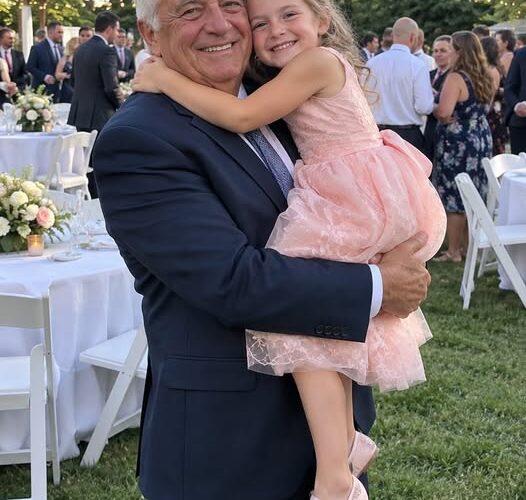
Margot stood beside her father.
She held his hand.
She laughed.
In one photograph, Emmett lifted her into his arms while she laughed against his shoulder.
Sofia captured the moment perfectly.
I still have that photograph.
It is one of my most treasured possessions.
Then came the reception.
And I realized I had something to say.
The Toast Wasn’t the One I Had Written
Emmett had asked me to give a toast.
I had prepared something pleasant and appropriate.
I didn’t give it.
When my name was announced, I stood with my glass in my hand.
Margot was sitting nearby at the children’s table.
Before saying anything else, I raised my glass toward her.
She raised her cup of apple juice.
Then I turned toward the room.
“When my daughter Phoebe died,” I began, “she left behind a husband who loved her and a daughter who needed her.”
I spoke about Emmett.
About the father he had become.
About the years he had spent making sure Margot was safe, loved, and supported.
Then I told the room what had happened that afternoon.
I didn’t shout.
I didn’t insult anyone.
I simply told the truth as I had witnessed it.
“A little girl in a pink dress was made to wonder whether she still mattered,” I said. “Whether she belonged in her own family’s photographs.”
The room became completely quiet.
I looked at Margot.
“She is five years old. She lost her mother when she was two. She carries an absence that no child should have to understand so young.”
Then I looked toward Claire.
“She deserves to know that she belongs.”
I paused.
“She deserves to be in the photographs. At Christmas. On birthdays. On ordinary Tuesdays. Not at the edge of the family, but as part of it.”
I wasn’t asking Claire to replace Phoebe.
No one could.
I was asking her to understand what it meant to become part of a family that already carried a profound loss.
I raised my glass.
“To Emmett and Claire,” I said. “And to the family they’re building. May it always be large enough for everyone who belongs in it.”
Then I sat down.
For several seconds, nobody spoke.
Then the applause began.
Emmett Came to Find Me
Later that evening, Emmett found me outside.
“You heard what she said to Margot,” he said.
“Yes.”
“I didn’t know.”
“I know.”
He looked toward the reception.
“What were you doing in there?”
I thought about it.
“Bearing witness,” I said.
I wanted Margot to know that someone had seen what happened.
Someone had heard.
Someone cared enough to speak.
Emmett was quiet.
“What do I do now?”
“Talk to your wife,” I said. “Not about the toast. About Margot.”
He nodded.
“She may have been acting out of insecurity,” I continued. “That doesn’t excuse what she said. But give her a chance to understand what she did and make it right.”
“And if she doesn’t?”
“Then we’ll deal with that if it happens.”
He looked toward the barn.
“She would have hated your speech,” he said.
I knew exactly who he meant.
“Phoebe?”
He nodded.
“She would have been much louder.”
We both laughed.
For a moment, the grief felt lighter.
Claire Came to Me Later
An hour later, Claire approached me.
She sat across from me at a quiet table.
“You heard me,” she said.
“Yes.”
She looked down at her hands.
“What I said was terrible.”
I waited.
She explained that she had been struggling with the idea of becoming a stepmother to a child whose mother was still so deeply loved and remembered.
She felt as though she was competing with someone who wasn’t even alive.
Then she looked at me.
“I took it out on a five-year-old.”
“Yes,” I said.
She swallowed.
“How do I fix it?”
I pointed toward the dance floor.
Margot was there, dancing without her shoes.
“You apologize,” I said. “Tomorrow, when things are quiet. Get down to her level and tell her you were wrong. Don’t explain it away. Don’t blame the wedding or your nerves. Just apologize.”
Claire nodded.
“I want to be good to her,” she said.
“Then show her.”
She looked toward Margot.
“I don’t know if I can be her mother.”
“You don’t have to replace her mother,” I said. “You just have to be someone who makes her feel welcome and loved.”
Claire was quiet.
Then she asked me something I hadn’t expected.
“Tell me about Phoebe.”
So I did.
I told her about my daughter.
About how she noticed small things.
How she loved completely.
How she would have taken fourteen pictures of Margot in that pink dress.
And how, despite everything that had happened, I believed Phoebe would have given Claire an opportunity to become better than her worst moment.
Claire listened.
Then she looked at the dance floor again.
“She’s amazing,” she said.
“Yes,” I replied.
“She really is.”
The Apology Came the Next Morning
The following morning, Claire apologized to Margot.
She got down on her level and told her she had said something wrong.
She told her she was sorry.
There were no excuses.
No explanations.
Just an apology.
Margot accepted it in the uncomplicated way that children sometimes can.
Then, according to Emmett, she asked Claire whether she wanted to see her shoes.
Apparently, Margot spent the next twenty minutes explaining the difference between the sounds made by different kinds of footwear.
That was Margot.
She didn’t forget what had happened.
But she was willing to move forward.
A Year Later
A year after the wedding, I received a photograph from Claire.
It was Margot’s birthday.
She was standing between her father and Claire.
She was laughing.
She was in the center.
The caption read:
“Our most important girl.”
I printed the photograph and placed it on my refrigerator beside an old photograph of Phoebe.
I looked at the two pictures for a long time.
I thought about the wedding.
The pink dress.
The shiny shoes.
The words I had heard through that open door.
The toast.
The apology.
And the possibility that one painful moment doesn’t have to define an entire relationship.
Phoebe would never come back.
Nothing could change that.
But Margot was still here.
She was growing.
She was laughing.
She was surrounded by people who were learning how to love her in the best ways they knew.
And that was what mattered.
I had once promised a five-year-old that she belonged in the picture.
A year later, she was exactly where she belonged.
Right in the center.