
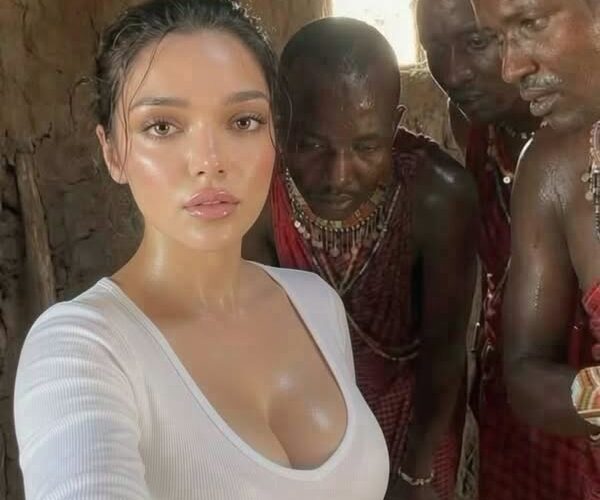

A photograph can show a moment. It cannot tell you everything about the people living in it.
So she arrived determined to observe, listen, and learn rather than assume she already understood what life would be like.
Beyond the Photographs
Before the trip, she had imagined that the biggest difference would be the surroundings.
Instead, what surprised her most was how quickly ordinary human connections became more important than those differences.
People welcomed her into conversations, introduced her to aspects of their daily routines, and shared stories about their families and community.
Some things were unfamiliar to her.
Other things felt surprisingly familiar.
People laughed together, worried about their families, celebrated important moments, worked toward better opportunities, and made plans for the future—experiences that cross cultural and geographic boundaries.
Learning to Listen
One of the biggest lessons from the visit was that she couldn’t understand an entire community from a few photographs or outside descriptions.
Every community has its own history, traditions, challenges, values, and individual personalities.
She began asking questions instead of relying on assumptions.
What she heard gave her a more nuanced understanding of the people she met.
She also realized that rural communities should not be viewed simply through the lens of what they may lack compared with urban areas.
Many people have strong relationships with their neighbors, traditions that are important to their identity, and knowledge shaped by generations of experience.
At the same time, rural communities can face real challenges involving infrastructure, healthcare, education, employment, transportation, and access to services.
Both realities can exist at the same time.
A Different Way of Seeing Everyday Life
As the days passed, ordinary moments became some of the most memorable parts of the trip.
Sharing a meal.
Watching people work.
Listening to conversations.
Seeing children play.
Learning about local customs.
None of these moments were necessarily dramatic.
But together, they gave her something that photographs never could: context.
She began to understand that meaningful travel isn’t always about seeing something extraordinary.
Sometimes it’s about slowing down long enough to understand something you previously viewed from a distance.
What She Took Home
When the visit ended, she returned home with photographs and memories, but also with a different way of thinking about travel.
She realized that visiting another place shouldn’t be about comparing one culture with another or deciding which way of life is “better.”
It can be about recognizing differences while also noticing the things people share.
Every community is more complicated than a single photograph can show.
And every person has a story that deserves to be understood on its own terms.
The Lesson That Stayed With Her
The experience reminded her of something simple:
You can read about a place for years and still learn something new when you finally meet the people who call it home.
For her, the journey wasn’t simply about visiting a remote community.
It was about replacing assumptions with curiosity—and discovering that genuine understanding often begins when you take the time to listen.