
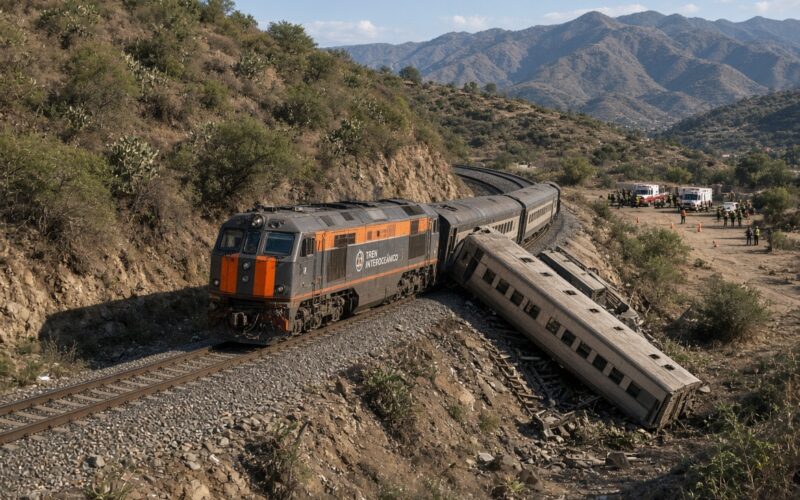

On the morning of December 28, 2025, a Tren Interoceánico passenger train traveling across Mexico’s Isthmus of Tehuantepec derailed near the community of Nizanda in the municipality of Asunción Ixtaltepec, Oaxaca. The train, which had 241 passengers and 9 crew members aboard (approximately 250 people in total), left the tracks while rounding a sharp curve known locally as la Curva de la Herradura (Horseshoe Curve).
The train had departed Salina Cruz on the Pacific coast at about 8:00 a.m. CST, bound for Coatzacoalcos on the Gulf of Mexico along Line Z of the Interoceanic Corridor. Around 9:28–9:30 a.m., roughly 90 minutes into the journey and a short distance before the Chivela station, the two locomotives and four passenger cars left the rails. The first carriage slid down a roughly 6.5-meter (21-foot) embankment; the second hung at a steep angle. The locomotives remained closer to the track.
Mexican authorities, including the Navy (which operates the line), reported 13 deaths in the immediate aftermath. A 14th person later died. Ninety-eight people were injured, with dozens requiring hospital treatment; several were listed in serious or critical condition. Among the dead was journalist Israel Gallegos Soto, director of Oaxaca Mundo News. The train’s driver was unhurt.
Rescue operations involved hundreds of Navy personnel, soldiers, civil protection teams, ambulances, and air support. Injured passengers were taken to hospitals in the region, including facilities of the Mexican Social Security Institute (IMSS). President Claudia Sheinbaum ordered senior officials to the site to assist families and announced immediate financial support for funeral expenses.
Cause: Excessive Speed
An official investigation by the Attorney General’s Office (FGR), using data from the train’s event recorder (“black box”), determined that the primary cause was overspeed. The train was traveling at 65 km/h (about 40 mph) on a curve where the authorized maximum was 50 km/h (31 mph). On earlier sections of the route, the recorder showed speeds of up to 111 km/h where limits were lower. No defects were found in the brakes or in the track at the derailment curve itself. The driver did not activate the emergency brake.
The driver was later arrested and faced charges related to culpable homicide and injuries stemming from negligent operation. Questions were also raised about the train’s maintenance history, wheel wear noted in a pre-incident inspection, and the fact that some operating licenses had expired years earlier, though officials stated those issues were administrative and not the direct cause.
Continue reading on the next page…