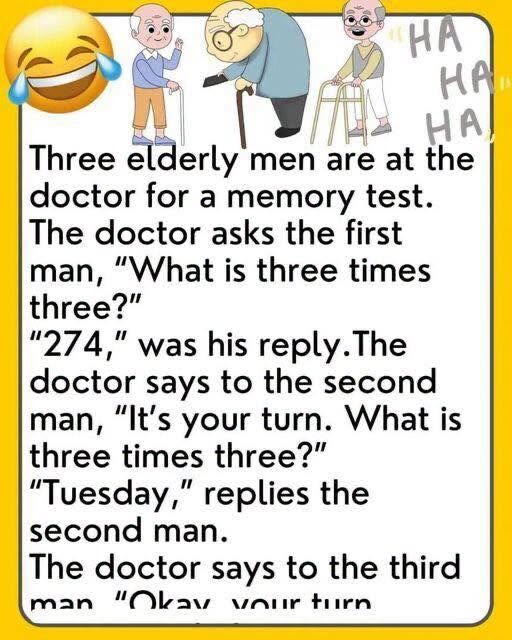
Then came Clarence.
He listened, considered the question, and produced an answer that seemed to bend the rules of mathematics entirely. For a moment, everyone in the room was caught between concern and an involuntary smile.
Dr. Halpern had seen countless patients complete similar assessments. He knew these questions were not designed to measure someone’s humor, personality, or life experience. They were tools that could help clinicians identify possible changes in memory and cognitive function.
Yet the encounter reminded him of something that no checklist could fully capture.
A person is always more than a collection of answers.
Memory can change with age for many reasons. Sometimes those changes are part of normal aging. In other cases, persistent or significant difficulties can be associated with medical conditions that deserve professional evaluation. That is why clinicians look at patterns over time rather than relying on one unusual response.
But personality doesn’t disappear simply because recall becomes harder.
A quick joke can still reveal a familiar sense of humor. A stubborn answer can reflect decades of character. A playful response can remind everyone in the room that there is still a whole individual behind the medical questions.
Dr. Halpern left the encounter with a deeper appreciation for that distinction.
The assessment mattered. The answers mattered. But so did the people giving them.
Aging can bring challenges, including changes in memory and concentration, but it doesn’t erase someone’s history, personality, relationships, or ability to make an impression.
Sometimes a medical appointment becomes more than a test.
Sometimes it becomes a reminder that every patient arrives carrying an entire lifetime of stories.
And even when a few facts become harder to retrieve, the person behind those facts remains worthy of patience, dignity, humor, and respect.
Have you ever had a surprisingly funny or memorable moment during a routine appointment? Share your story in the comments.