The cancer had spread too far.
“If the disease continues progressing like this,” he said quietly, “you most likely have about four to six weeks left.”
Emily squeezed my hand.
I could see the fear in her eyes.
But I also saw something else.
Acceptance.
On the drive home, she barely spoke.
Finally, she whispered:
“You should leave me.”
I glanced at her.
“What?”
“You heard the doctor.”
“I heard him.”
“Then you know what this means.”
I pulled the car over.
“Emily, look at me.”
She turned toward me.
“I didn’t fall in love with you because I thought we’d have a certain number of years together.”
She started crying.
“I don’t want you to spend the rest of your life remembering me as the woman who made you watch her disappear.”
I reached for her hand.
“Then don’t make that decision for me.”
She stared at me.
“I already made my decision.”
“I love you.”
She looked away.
“I love you too.”
“Then we’re getting married.”
She shook her head.
“You don’t have to.”
“I know.”
“And you’ll regret it.”
“Maybe I’ll regret a thousand things in my life.”
I squeezed her hand.
“But loving you won’t be one of them.”
A few days later, we canceled the large wedding we’d planned.
Instead, I invited our families, a priest, and a few close friends to our backyard.
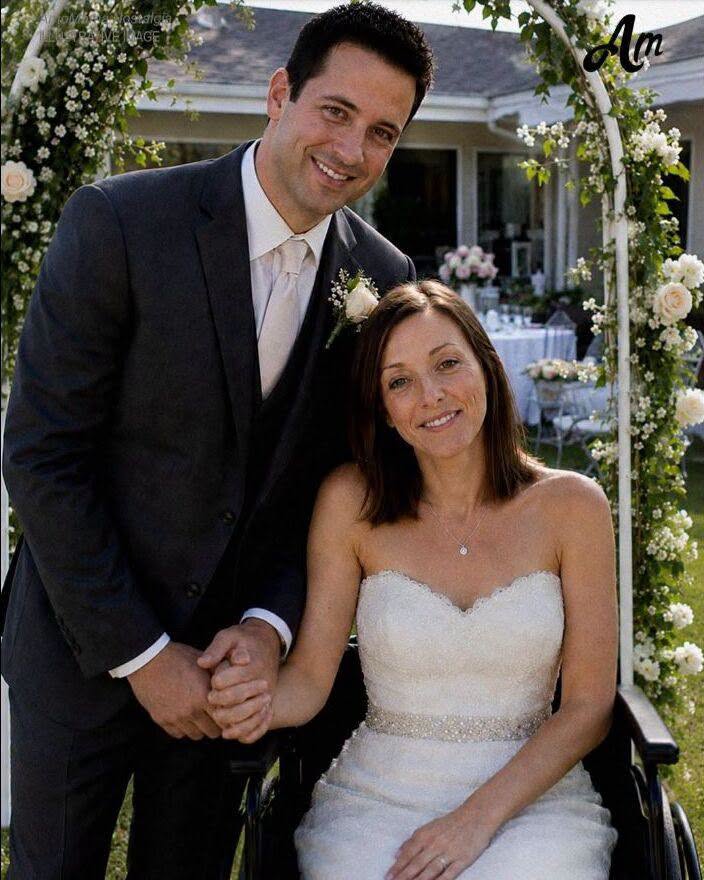
Emily wore the wedding dress she had chosen months earlier.
She couldn’t walk down the aisle, so I gently wheeled her toward the small gathering beneath the trees.
When she reached me, she smiled.
It was the brightest smile I’d seen from her in weeks.
We said our vows.
We exchanged rings.
And when the priest pronounced us married, everyone around us began to cry.
Emily simply laughed.
That evening, she whispered:
“Thank you.”
“For what?”
“For giving me a wedding instead of a goodbye.”
I kissed her forehead.
“We have plenty of time.”
She looked at me strangely.
Neither of us said anything else.
She lived for another three weeks.
Three weeks as my wife.
Three weeks filled with ordinary moments that somehow became more precious than anything we’d ever planned.
We ate breakfast together.
We watched old movies.
We sat outside when the weather was nice.
We talked about the future, even though we both knew our future together had become painfully uncertain.
Sometimes Emily would fall asleep holding my hand.
I would sit beside her and simply listen to her breathing.
I wanted to memorize everything.
Her laugh.
Her favorite expressions.
The way she took her tea.
The way she always folded blankets before going to bed.
The little things.
Especially the little things.
Then one morning, Emily was gone.
The house became unbearably quiet.
I didn’t know how to exist inside it without her.
At the funeral, I stood beside her family and tried to remain composed.
People hugged me.
They told me she had been lucky to have me.
But I didn’t feel lucky.
I felt empty.
For several days afterward, I barely left the house.
Then, one morning, someone knocked on my door.
A man stood outside.
He introduced himself as Emily’s lawyer.
“I need to give you something.”
He handed me a small wooden box.
I stared at it.
“What’s this?”
“Emily left it for you.”
My heart began racing.
He continued:
“She made me promise not to give it to you until after her death.”
I looked at him.
“Why?”
“I don’t know if I’m the right person to explain.”
I carried the box inside.
The lawyer followed me.
There was a small metal clasp on the front.
I opened it.
Inside was an envelope.
My name was written on it in Emily’s handwriting.
Underneath the envelope was a key.
I picked it up.
“What does this open?”
The lawyer looked at the key.
“You’ll find out.”
I stared at him.
“You’re not going to tell me anything?”
Emily’s lawyer shook his head.
“She was very specific.”
I opened the envelope.
Inside was a letter.
The first line read:
My love, if you’re reading this, I’m finally gone—and there is something I’ve been hiding from you.
I stopped reading.
My hands began shaking.
The next sentence made my heart sink.
Please don’t hate me. Everything I did was because I loved you.
I looked at the lawyer.
“What did she do?”
He remained silent.
I continued reading.
Emily explained that several months before her diagnosis, she had discovered something about my family.
Something I had never known.
My father had apparently left behind an account in my name.
Not a normal bank account.
A trust.
She had discovered it while helping me organize some old family documents.
According to the letter, my father had established the trust decades earlier.
But there was a condition.
I couldn’t access it until I reached a certain age.
And Emily had discovered something else.
The trust contained enough money to completely change my financial future.
I stared at the page.
“Why didn’t she tell me?”
The lawyer finally spoke.
“Because she didn’t want you to make decisions about your life based on money.”
I looked at him.
“But she knew about it.”
“Yes.”
“How long?”
“Almost a year.”
I sat down.
Emily had known.
She had known about the trust while we were planning our wedding.
She had known while we were choosing flowers.
She had known while we were discussing our future.
And she’d never said a word.
But there was more.
I turned the page.
The next paragraph explained why.
Emily had discovered that my father had created the trust for one reason.
He wanted me to use it to help people who had helped our family when we had almost nothing.
And Emily had decided to honor that wish.
She had quietly contacted the lawyer.
She had arranged for the trust to remain untouched.
Then she had done something that left me speechless.
She had added her own instructions.
If she died before me, the money would be placed under my control.
But I could only access the full amount if I agreed to establish a small foundation in her name.
A foundation that would help families facing serious illness with practical expenses such as transportation, meals, and temporary household support.
I looked up at the lawyer.
“She planned all of this?”
He nodded.
“She spent the final months making arrangements.”
I felt tears running down my face.
“But why keep it secret?”
The lawyer looked at the box.
“There’s one more thing.”
He pointed toward the key.
“That key is not for the trust.”
I stared at it.
“Then what is it for?”
He gave me an address.
It was an old storage facility across town.
I drove there that afternoon.
The key opened a small storage unit.
Inside were dozens of cardboard boxes.
Photographs.
Letters.
Old birthday cards.
Receipts.
Wedding plans.
And one large scrapbook.
I opened it.
The first page contained a photograph of Emily and me from the day we met.
Underneath it, she had written:
The day I met the man I would spend my life loving.
I turned the page.
There was another photograph.
Our first apartment.
Then another.
Our first vacation.
Our first Christmas together.
Every ordinary moment we had shared was there.
But the final pages were different.
They contained photographs from our wedding.
Pictures of Emily smiling in her dress.
Pictures of our families.
A photograph of us beneath the trees in our backyard.
And beneath that final photograph was one sentence:
You gave me the wedding I thought I would never have. Now let me give you the future I hope you deserve.
I closed the scrapbook.
For the first time since Emily’s death, I didn’t feel completely broken.
I still missed her.
I knew I would for the rest of my life.
But suddenly I understood something.
Emily hadn’t been preparing for her death.
She had been preparing for my life after she was gone.
The lawyer handed me one final envelope.
“She told me to give you this only after you found the scrapbook.”
I opened it.
There was a short letter inside.
My love,
You once told me that loving someone isn’t about knowing how long you have together.
You were right.
Our time was shorter than we wanted, but it was real.
Please don’t spend the rest of your life mourning the time we lost.
Build something with the time you have left.
Help someone. Laugh again. Travel somewhere I’ve never been. Eat dessert before dinner once in a while.
And when you eventually fall in love again, don’t feel guilty.
I won’t be there to be jealous.
I laughed through my tears.
That sounded exactly like Emily.
Then I read the final line.
You were never supposed to save me. You were supposed to love me. And you did.
I held the letter against my chest.
For months, I had believed that I had married Emily because she was dying.
But I finally understood the truth.
I hadn’t married a dying woman.
I had married the woman I loved.
And she hadn’t left me with a fortune.
She had left me with something much harder to measure.
A reason to keep living.
A reason to help others.
And a reminder that sometimes the greatest love story isn’t the one that lasts the longest.
It’s the one that changes what you do with the time you have.
Years later, the foundation Emily had requested was still operating.
Every time I helped another family, I thought of her.
Every time someone thanked me, I remembered the words she had written.
And every year, on the anniversary of our wedding, I returned to the backyard where we had exchanged our vows.
I would sit beneath the same trees.
I would look at the place where Emily had smiled at me for the last time.
And I would whisper:
“Thank you for choosing me.”
Because in the end, Emily’s greatest secret wasn’t the money.
It wasn’t the trust.
It wasn’t even the box.
It was the fact that while I had spent every day trying to give her more time, she had spent her final days quietly making sure that I would know how to live when our time together was over.