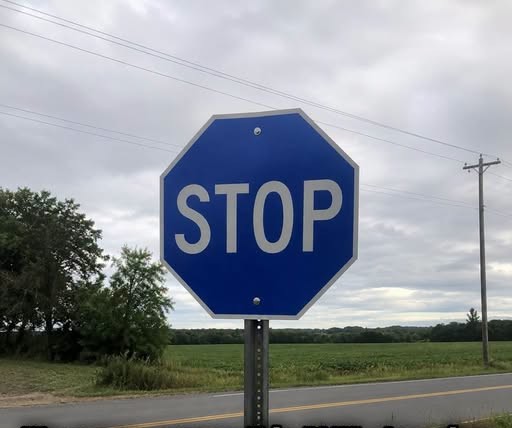
Why Blue Stop Signs Exist—and What Drivers Should Actually Do
Imagine driving through a neighborhood, parking complex, or business property when something suddenly catches your eye.
It looks exactly like a stop sign.
Same familiar octagonal shape. Same clear instruction.
But instead of red, it’s blue.
For many drivers, that small change is enough to create immediate confusion. Is it legal? Is it official? Are you actually required to stop? Or is it simply decorative?
Blue stop signs are unusual, but there is usually a straightforward explanation behind them.
In most cases, they are found on private property rather than ordinary public roads, where property owners use their own traffic-control signs to organize vehicles and reduce the risk of collisions.
Here’s what blue stop signs generally mean, where you may encounter them, and the safest way to respond.
Why Does a Blue Stop Sign Look So Strange?
Drivers become extremely familiar with standard traffic signs.
You probably don’t consciously analyze a red stop sign every time you approach one. Years of repetition teach your brain to recognize its shape and color almost instantly.
Red octagon = stop.
That reaction becomes automatic.
A blue stop sign interrupts that familiar pattern.
Your brain recognizes the octagonal shape and the word STOP, but the unusual color creates a moment of uncertainty.
That is exactly why these signs attract so much attention.
They look familiar enough to understand immediately, yet unusual enough to make drivers wonder whether something is wrong.
Where Are Blue Stop Signs Usually Found?
Blue stop signs are generally associated with privately managed roads and properties rather than standard government-controlled streets.
You may encounter them in places such as:
- gated residential communities
- apartment complexes
- private parking lots
- business parks
- corporate campuses
- industrial properties
- private roads
- large commercial developments
These locations can contain surprisingly complicated traffic patterns.
Cars may enter from multiple directions, pedestrians may cross between buildings, vehicles may pull out of parking spaces, and drivers may approach intersections with limited visibility.
Property owners therefore need some way to organize traffic.
Installing stop signs is one of the simplest methods.
Why Would Someone Make a Stop Sign Blue?
On public roads, traffic signs generally follow established standards so that drivers can recognize them quickly and consistently.
Private properties can sometimes use signage that looks different.
A property owner may choose another color to distinguish private traffic-control signs from official roadway signs.
In other situations, the sign may simply have been purchased or designed differently.
Either way, the purpose is usually obvious:
Drivers approaching the intersection are being asked to stop.
The unusual color does not necessarily mean the sign is meaningless.
Is a Blue Stop Sign an Official Traffic Sign?
This is where the distinction becomes important.
A blue stop sign on private property generally should not automatically be treated as equivalent to a standard red stop sign installed by a public traffic authority.
Its regulatory status can depend on the property, location, and applicable local laws.
But focusing only on whether the sign is technically official misses the bigger issue.
Ask yourself:
Why was a stop sign placed there in the first place?
Usually, it is because the location contains a point where vehicles, pedestrians, or traffic paths intersect.
Ignoring that completely can still create a dangerous situation.