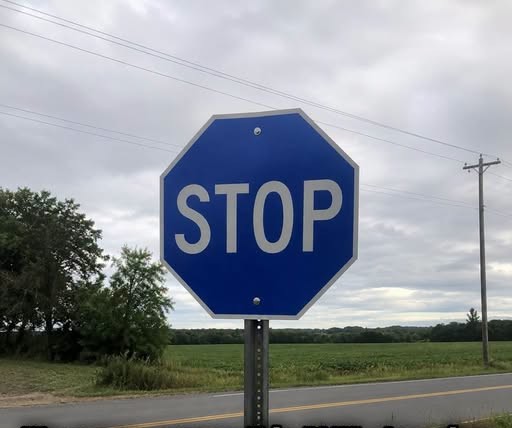
Why Ignoring a Blue Stop Sign Can Be Risky
Suppose you approach a blue stop sign inside a large parking complex.
You assume it isn’t official, so you keep driving.
But another driver approaching from the opposite direction sees the sign and stops.
A third vehicle may be entering from another lane.
Now different drivers are following different expectations.
That unpredictability is exactly what traffic-control systems are designed to reduce.
Even if a sign exists primarily as part of a private traffic system, stopping can still prevent:
- low-speed collisions
- pedestrian accidents
- parking-lot crashes
- confusion over right-of-way
- unexpected vehicle conflicts
A few seconds of caution can prevent a much larger problem.
The Safest Thing to Do When You See One
The simplest answer is also the most practical:
Stop.
You do not need to conduct a roadside legal analysis before deciding what to do.
Come to a controlled stop.
Look left.
Look right.
Check for pedestrians.
Watch for vehicles entering from parking spaces or nearby lanes.
Then continue when the path is clear.
You lose only a few seconds.
The alternative could be entering an intersection where another driver expects you to stop.
Why Standard Sign Colors Matter So Much
Blue stop signs also reveal something interesting about how people drive.
We rely heavily on visual patterns.
Traffic signs are deliberately standardized because drivers often have only seconds to recognize information and react.
Shapes, colors, symbols, and positioning all help the brain process road conditions quickly.
A traditional stop sign works so well because almost every driver already knows what it means before reading the word.
When one part of that familiar design changes, such as the color, recognition becomes slightly slower.
That hesitation is one reason consistency matters so much in traffic design.
Private Roads Still Need Traffic Rules
A road does not suddenly become risk-free because it sits on private property.
Large residential developments, shopping centers, campuses, and parking areas can experience heavy traffic.
Vehicles still cross paths.
Pedestrians still walk between cars.
Drivers still pull out from hidden areas.
And intersections still need some kind of organization.
Private traffic signs help property owners create predictable movement.
That is often what a blue stop sign is doing.
It may not look like the familiar sign you see on a city street, but its practical purpose can be very similar.
Don’t Assume It Is Just Decoration
Because blue stop signs look unusual, some drivers may assume they are decorative signs or novelty items.
That assumption can be risky.
Look at the surroundings.
Is the sign positioned beside an intersection?
Does another road enter from the side?
Are pedestrians nearby?
Are vehicles exiting a parking area?
If the answer to any of those questions is yes, the sign was probably placed there for a reason.
Treating it seriously is the safer choice.
What If Another Driver Ignores It?
This is another reason defensive driving matters.
You may stop at a blue stop sign while another driver decides to ignore it.
Do not assume that because you followed the sign, everyone else will do the same.
Before moving forward, check the entire intersection.
Watch for vehicles that appear unlikely to stop.
Make eye contact with other drivers when possible.
Proceed only after you are confident the path is clear.
Predictability is ideal, but defensive driving means preparing for people who behave unpredictably.
Are All Blue Stop Signs the Same?
No.
A sign’s purpose and status can vary depending on where it is installed.
A sign inside a private apartment complex may be managed by the property owner.
Another inside a large industrial facility may be part of an internal safety system.
One inside a private parking structure may primarily help organize vehicles.
That is why drivers should avoid making broad assumptions based entirely on color.
The surroundings matter.
The Simple Rule Drivers Should Remember
You do not need to memorize every possible reason a blue stop sign exists.
Just remember this:
Unusual color doesn’t automatically mean unimportant.
If an octagonal sign clearly tells you to stop at an intersection or potential traffic conflict point, stopping is usually the safest response.
Take a few seconds to check your surroundings before continuing.
That simple decision removes most of the uncertainty.
The Bottom Line
A blue stop sign can look bizarre because drivers are conditioned to associate stop signs with red.
But there is usually nothing mysterious about it.
Blue stop signs are most commonly encountered on private properties where owners or managers need to organize vehicle traffic.
Their appearance may differ from standardized public-road signs, but the location they mark can still involve real traffic risks.
When you see one, don’t overthink it.
Stop, check your surroundings, and continue when it is safe.
A strange-looking sign may grab your attention, but choosing caution behind the wheel is rarely a bad decision.
Have you ever seen a blue stop sign in real life? Tell us where you spotted it—and share this with someone who would definitely stop and stare at one.