
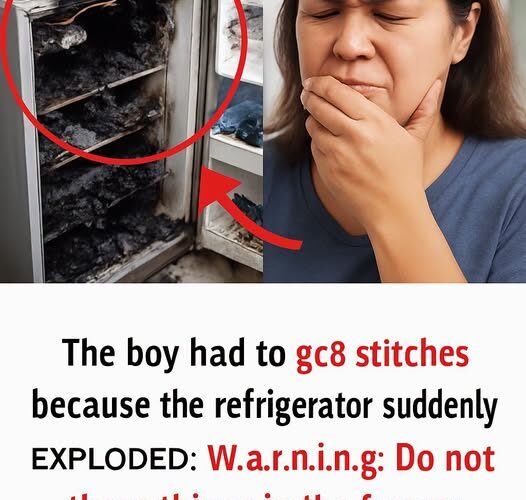

What Happened?
The exact circumstances can vary depending on the object involved, but the danger usually comes down to expansion and pressure.
Water expands when it freezes. Liquids trapped inside a tightly sealed container can therefore put enormous pressure on the container as they turn to ice.
If the container can’t flex or accommodate that expansion, it can crack, split, or rupture.
And when a sealed container fails suddenly, the result can be surprisingly violent.
That’s why the man who expected nothing more than a cold item ended up needing medical treatment and eight stitches.
Things You Should Never Put in the Freezer
You should be especially careful with anything that is sealed, pressurized, or not designed for freezing.
- Sealed glass bottles filled with liquid — expanding liquid can crack or shatter the glass.
- Carbonated drinks in sealed containers — freezing can increase pressure and damage the container.
- Cans of soda or other beverages — liquid expansion can cause the can to rupture.
- Sealed jars filled to the top — there needs to be room for liquids to expand.
- Pressurized aerosol cans — these should be stored according to the manufacturer’s instructions, not casually frozen.
- Containers that aren’t freezer-safe — some plastics and other materials can become brittle at low temperatures.
- Unopened containers with unknown contents — if you don’t know whether something is freezer-safe, don’t experiment.
The Biggest Mistake: Sealing Liquid With No Room to Expand
One of the most important rules is simple:
Don’t freeze liquids in completely full, tightly sealed containers unless the container is specifically designed for freezing and the manufacturer says it’s safe.
If you’re freezing food or liquids in an appropriate freezer-safe container, leave the amount of headspace recommended by the container or recipe. That gives the contents room to expand.
And don’t assume that because a container is made of glass or plastic, it’s automatically safe for the freezer. Look for a manufacturer’s freezer-safe designation and follow its instructions.
Why the Freezer Can Be Deceptively Dangerous
A freezer doesn’t look dangerous.
There’s no flame. No sharp machinery. No obvious source of pressure.
But freezing changes the physical properties of materials.
Liquids can expand. Some materials become more brittle. Sealed containers can trap pressure. And something that looks perfectly normal when it goes into the freezer may behave very differently after several hours at a low temperature.
That’s why a few seconds of convenience isn’t worth taking a risk.
The man who needed eight stitches probably never imagined that putting something in his freezer would end with an emergency-room visit.
But that’s the lesson.
If a container is sealed, pressurized, fragile, or not clearly labeled as freezer-safe, don’t gamble with it.
A freezer is meant to preserve food—not turn an everyday mistake into a trip for stitches.
And sometimes, the safest decision in the kitchen is simply knowing what not to put inside.