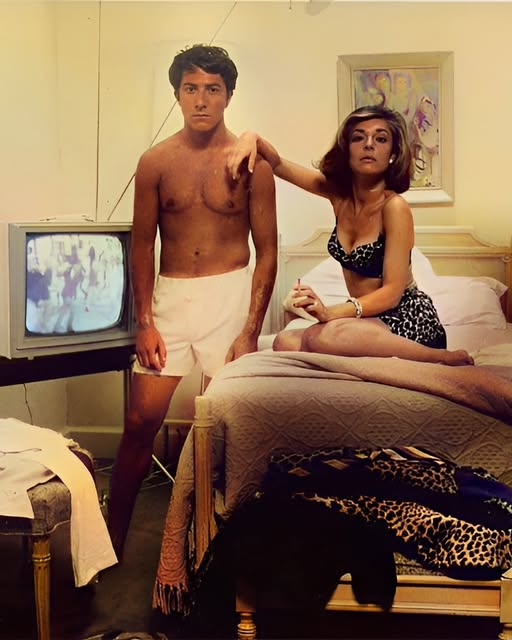
The film’s approach extended far beyond casting. Its tone also broke from tradition. It shifted between comedy and discomfort, silence and tension, without offering clear emotional guidance. Instead of explaining how viewers should feel, it allowed moments to unfold naturally, often lingering in awkwardness rather than resolving it.
That stylistic uncertainty initially made the project feel risky.
But it also made it feel real.
Anne Bancroft’s performance added another layer of complexity. Her portrayal of Mrs. Robinson became one of the most iconic aspects of the film. The character embodied contradiction—confidence mixed with dissatisfaction, control mixed with emotional distance.
On screen, she represented something provocative and emotionally layered, far removed from typical character archetypes of the time. Her performance helped define the film’s tension between desire, control, and disillusionment.
Yet, like many powerful roles, it also shaped how she was perceived long after the film’s release, becoming one of the most enduring associations of her career.
Behind the scenes, the production itself remained in a constant state of uncertainty. Scenes evolved during filming, tones shifted organically, and creative decisions were often made based on instinct rather than rigid planning. Nichols maintained a delicate balance between structure and spontaneity, allowing imperfections to remain rather than forcing them into polished resolution.
That approach carried real risk. Too much freedom could have led to inconsistency, while too much control might have stripped away the film’s emotional honesty.
The result was a careful equilibrium that gave the film its distinctive voice.
When The Graduate was released, it quickly became clear that audiences were responding to something different. The story did not offer simple answers or neatly resolved arcs. Instead, it reflected confusion, uncertainty, and emotional disconnection—feelings that many viewers recognized but rarely saw represented so directly on screen.
That sense of honesty turned the film into a cultural touchpoint.
What had begun as a risky creative experiment evolved into a defining moment in cinema history. It sparked conversation, interpretation, and debate, and it continues to be studied for its bold creative choices.
Looking back, it is easy to frame its success as inevitable. But in reality, it could just as easily have failed. A different casting decision, a more traditional tone, or a safer narrative structure might have made it easier to market—but also far less memorable.
What made The Graduate endure was its refusal to follow expectations.
It embraced discomfort. It trusted unconventional choices. And it allowed emotion to exist without forcing resolution.
In the end, its legacy is not just about storytelling—it is about creative courage.
Because the films that last are rarely the ones that play it safe.
If this story changed how you see The Graduate, share it with someone who loves film history—and explore more behind-the-scenes stories that shaped cinema.